
How to remove water from the fuel tank?
In the summer, the water in the gas tank usually does not make itself felt. But in the cold season, this can cause a lot of problems for the rider. A car that has been parked on the street all night may simply not leave. This is due to the fact that moisture from the tank often gets into the fuel line and freezes there, preventing the fuel from circulating. Therefore, it is necessary to pay attention to its removal from the system in advance, before the onset of frost. So how do you do it?
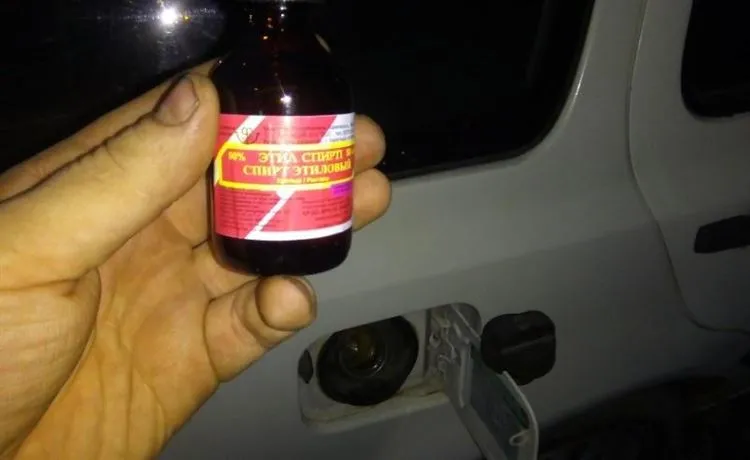
Ethanol
Water does not dissolve in gasoline, so it settles to the bottom of the tank. But it mixes very well with alcohol. This is his property, which is used by drivers. Also, theoretically, almost any alcohol, including methyl alcohol, is suitable. However, in practice, ethanol or isopropanol is more commonly used. The main thing is that it should not be diluted.
When alcohol is added to a gas tank, it combines with water. It turns out a substance with a density close to the density of the fuel. As a result, water molecules rise up, enter the fuel line and are gradually consumed in the engine along with the fuel. Also, the resulting mixture ceases to freeze when the temperature drops, which is also important.
When exactly to pour alcohol and in what quantity? Experienced motorists recommend adding it to the fuel immediately before refueling. Open the tank cap, pour 500 ml of alcohol into it and fill as usual. This amount is based on a full tank of gasoline. If you're going to fill it halfway, cut the amount of alcohol in half.
If you choose methanol to remove water, handle it with care. Remember that its fumes are dangerous. Therefore, only work with it outdoors or in a well-ventilated area. And avoid contact with mucous membranes.
Image source: drive2.ru
Acetone
The octane number of acetone is approximately 100. This fact must be taken into account when adding acetone to the tank. This solvent slightly increases the octane number of the fuel itself. Add 500 ml of acetone to half of the fuel tank.
The solvent, like alcohol, mixes with water at the bottom of the tank. The resulting liquid then rises and burns in the cylinders. For preventive purposes, this procedure should be carried out once a year.
Shop dehumidifiers
On sale you can find ready-made products for removing water from a gas tank. The average cost of such liquids ranges from 100 to 600 conventional units. These additives are able to bind water and melt already formed ice, and also make it easier to start the engine at low temperatures.
The main components of most industrial fuel dryers are alcohols and solvents (for example, an aliphatic solvent). Surfactants (surfactants) perform an auxiliary function. Therefore, there is no fundamental difference between factory fluids and improvised means.
mechanical way
Those who prefer to see the result with their own eyes drain the water from the tank using a hose. This is a labor intensive and time consuming method. However, sometimes it turns out that this becomes the only way out of the situation. Why?
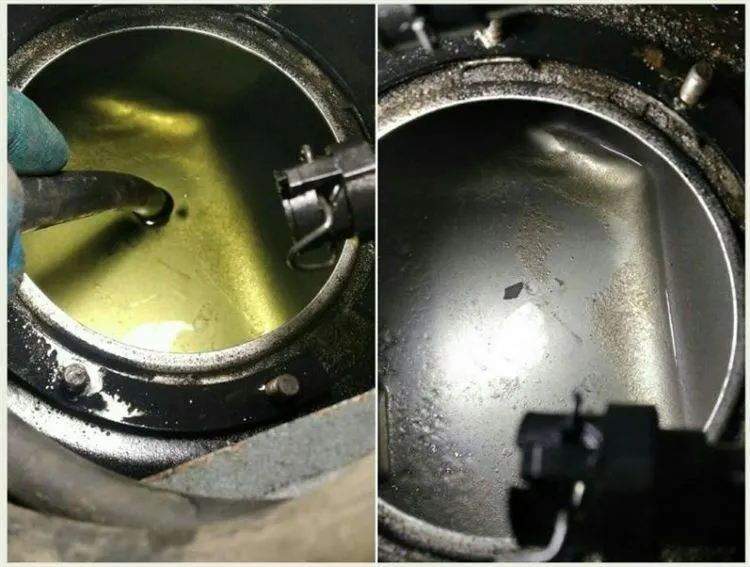
Image source: rudorogi.ru
The fact is that the volume of water circulating in the tank can vary from 100 ml to 1 liter. Therefore, it is impossible to blindly guess how much alcohol or acetone should be poured in order to completely bind moisture. Therefore, sometimes the driver adds a dryer, refills the tank and calms down on this. And with a sharp drop in temperature, it suddenly turns out that the engine still does not start. And then it remains to resort to mechanical cleaning of the tank and fuel line.
To remove water, you need to remove the fuel pump and dip one end of a thin tube into the gas tank. The second is placed in the bucket located one level below.
Remember that alcohol and acetone are not suitable for diesel vehicles. For such vehicles, only special additives are allowed. In addition, almost all modern diesel engines have a special drain hole in the fuel tank. Therefore, when the water sensor located in the fuel filter is triggered, to remove moisture, it is enough to replace the empty container and unscrew the cap. The procedure is combined with the replacement of the filter itself.
