
date and history. Car Turin
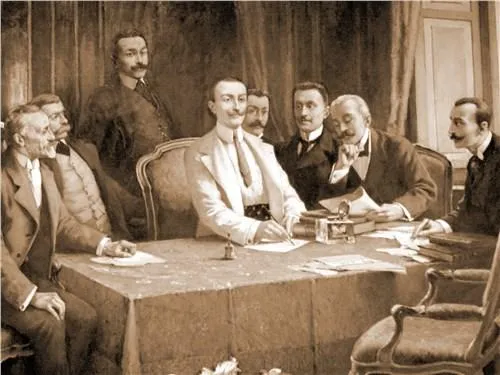
The Founding Fathers of Fiat at the Founding Assembly
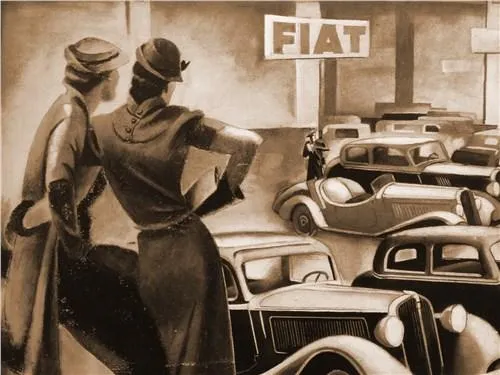
Promotional propaganda posters from the 1930s
The company has been present on the current market since the beginning of the 20th century.
In the summer of 1899, a new car manufacturer appeared in Italy – Fabrica Italiana di Torino – F. A. I. T. over time, the company became known throughout the world, and now, on July 11, 2019, the brand celebrates 120 years
It all started a couple of years before the official birth of the company through an interest in new technology from one of the most respected families in the area – Giovanni Agnelli. He was born in 1866 in Villar Perosa, near Turin. The boy's father was the mayor of this city, but he died as soon as his son, five years had passed. The family decided that Giovanni should be a military man. He did so, but after serving as a cavalry officer for eight years, he retired in 1892. He then received his law degree in 1895 and was also elected Mayor of Villar-Perosa. In addition, Giovanni Agnelli keeps a close eye on the latest advances in technology, in particular with the development of the automotive business. Soon, Signor Agnelli came to the conclusion that the future belongs to cars, and decided to organize a company to free them.
New business
Through contacts in the business community, Agnelli was able to convince eight Turin aristocrats, businessmen and bankers to invest in the new venture. Among the founders, Agnelli, was Count Biscaretti Carlo Di Ruffia, financier Emanuele Britannia and a number of other equally respected people. The management of the firm was entrusted to Giovanni Agnelli, who, as a former military man, knew a lot about discipline and organization.
The first model of the new brand was a small carriage, named the Fiat 3½, in keeping with its financial capabilities. The car was built in 1899. In the body-du-Park, passengers and driver were placed opposite each other, the 679 cm3 2-cylinder engine was located behind and actually gave up to 4.5 hp. with. at 400 rpm, with a maximum speed of 35 km/h.
In 1900, the company's first factory opened in Turin, employing 35 people. A huge plus Agnelli was the ability to pick up shots. Suffice it to say that in the initial period, such specialists as Aristide Pacioli, Vincenzo Lancia and Felice Nazzaro, the famous race car driver, worked in it. Thanks to their efforts, the brand began to conquer the market. In 1903, the firm exported its cars to France, Great Britain, and soon he came to America. The range of products was expanded along with the passenger, and cargo models appeared, which are distinguished by simplicity and reliability, which allowed Fiat to secure military orders, which gave the company the opportunity to reach a qualitatively new level.
Strengthening the prestige and ensuring successful technological innovation. So, in 1906, a car with a 6-cylinder engine and a pneumatic starter was built, which was a rarity in Europe. In addition, Fiat was one of the first in the Old World to purchase a conveyor.
Giovanni Agnelli was not only a talented administrator, but also a man who knew how to stay afloat under any political regime, whether it was a monarchy or the dictatorship that came to replace Mussolini. The company gradually picked up a number of non-automotive industries, including energy, metallurgy, shipbuilding, aviation, manufacturing, press… at the same time, serious attention was paid to social programs, cooperation with trade unions, which made it possible to avoid conflicts with employees.
By the middle of the twentieth century, Fiat had become a “state within a state”. To get back to work was considered incredible luck. For many Italians, it's almost like a lucky lottery ticket: got a job – I think life is good! Today, Fiat is another of the world's largest brands, which includes brands such as Ferrari, Maserati, Alfa Romeo, Abarth, Lancia, Chrysler and Jeep.
Despite the years
The company's cooperation with Russia was established at the beginning of the twentieth century. At the international automobile exhibition of 1907 held in St. Petersburg, the company's stand was located directly opposite the entrance, and the models exhibited here attracted the attention of specialists and the public. Success was consolidated at the next exhibition to run from Moscow to St. Petersburg, where the current racer and owner of a trading house from St. Petersburg, M.A. Fokin, won the fiat third place, covering the distance in 13 hours, 54 minutes. While Fokin was a Fiat representative in St. Petersburg, his shop was located on Troitskaya Street at 18. The entrepreneur was given a full warranty on the car and is sold for cash only.
Gradually its influence, the firm has expanded to the south in recent times. In 1909, the management of the Sevastopol port purchased three Italian trucks and several cars. The company's car has been sold in Moscow and other cities, the brand has successfully participated in rallies and races, including the Imperial Prize. Rally St. Petersburg-Sevastopol Fiat won one of the prizes, and the Moscow-Riga Turin rally won six awards with electrical goods.
All this contributed to the growth of the brand's popularity. In Moscow, for example, in 1909 there were 12 car brands, in 1910 – 28, and a year later – 36. During this period, Fiat firmly entered the top ten most popular car brands in the Mother See. In St. Petersburg, the situation was similar: in 1911, 27 car manufacturers were registered, in 1912 – 33. The Russian military also showed interest in the brand. In particular, Fiat was involved in several court proceedings organized by the war department, including the mileage of trucks, organized by the company's technical training in 1912.
When in 1916 the question arose of building their own automobile factories, one of them – AMO – decided to start producing Fiat models. The annual production volume is planned to be 750 trucks and 1500 cars. The FIAT 15-Ter became the trolley for production at AMO, which had an optimal load capacity for many roads, a carrying capacity of 1.5 tons. The launch of the plant was scheduled for March 1917, but due to interruptions in supplies at this time, to take the plant completely failed. In order to fulfill obligations to the state, its owners brought several hundred sets of parts from Italy and set up the assembly of cars. This work continued until 1919 and 1319 cars were produced.
It is interesting that in 1917 the interests of the company in the Empire were represented by the “Russian Joint Stock Company of Fiat Automobiles”, on board of which it was located in Petrograd on Bolshaya Konyushennaya Street, 25. At the same time, in Moscow, Kharkov, Odessa, Riga, Baku, Kyiv, Rostov-on-Don and other cities had ten branches of the brand.
It so happened that relations between the Soviet and Fiat have long been broken. Although sporadic contacts have been so far. In 1923, the company took part in the National Exhibition, and then took part in several tenders announced by the USSR government, but without much success. We know about the supply of cars for work in a Moscow taxi. In the 1930s, the company was part of Fiat, was involved in the design of the bearing and foundry and in Moscow. The point is, however, everything is limited.
But in the mid-1960s, when the need arose in the Soviet Union to build a factory for the mass production of automobiles, the leadership of the Soviet Union was addressed to Turin. And society reacted to this appeal – the Volga Automobile Plant appeared in Togliatti, and the Fiat 124 model became the prototype of its first product.
