
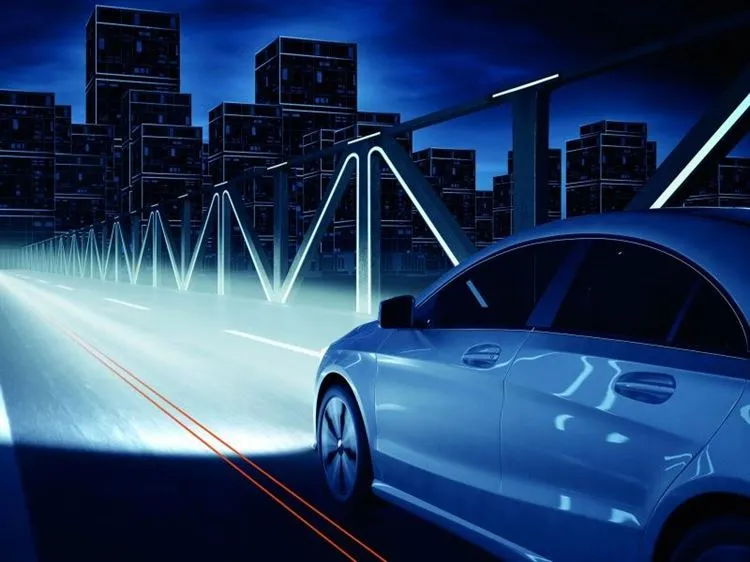
Lamps “light +”: how does it work, where is the truth and where is the deceit?
Is it possible to increase the efficiency of the head light without buying a new car and without purchasing xenon headlights from more expensive trim levels of your model at a disassembly? Can. For this, the so-called “high-brightness lamps” are intended – “+ 100%”, “+ 120%”, “+ 150%” and so on. However, how it all works and what the catch is is still a mystery to many motorists. Therefore, fierce disputes are endlessly started around the “light +” lamps, almost worse than oil holivars and battles like “thorns VS Velcro”…
So-called “increased brightness” bulbs regularly generate controversy in the automotive community. People do not fully understand their essence and the principles inherent in the design – phrases are constantly heard that these lamps blind oncoming drivers, that they violate Ohm's law and that this is generally a fiction… The manufacturers, who initially did not explain clearly and distinctly the essence of this, are partly to blame for the misunderstanding directions to consumers, but only began to increase the percentage of “plus” from year to year. “Wheels” propose to stop holivars once and for all, revealing all the secrets of “light +” lamps.
So let's go!
Power
The power of an incandescent lamp is proportional to its brightness. And how many headlights were damaged by lamps of increased, compared to the standard, power, inserted at random, thoughtlessly – one cannot count…
A car headlight is designed for a strictly defined lamp power, and it is impossible to increase it by simply inserting a lamp with the same base, but with increased watts, into the cartridge. Everything deteriorates – glass, reflector, wiring, relay. With an increase in power, the consumed current and heat dissipation increase: the polycarbonate glass of the headlight overheats and becomes cloudy, the wiring insulation softens from excess amperes, the wires in the bundle close together….
Therefore, high-brightness lamps are NOT POWERFUL! Their power strictly corresponds to the regular one. If you have a regular 55-watt H7 lamp in your headlight from the factory, then ANY high-brightness lamp that has ECE approval (even “+20%”, even “+200%) will also consume 55 watt!
Brightness
Many of us in barefoot childhood believed that “the cooler the car, the more powerful everything is!”. A stronger motor, brighter headlights, and so on… As for the motor, it's probably fair, but this doesn’t work with headlights…
The power of the headlights (and the brightness resulting from it) are strictly standardized at a compromise level – so that the road is sufficiently illuminated and the drivers of oncoming cars are not blinded. It is strictly forbidden to increase the brightness at will, and not a single automaker and no manufacturer of car lamps does this. Both a high power lamp and a headlight with such a lamp will never pass the certification, which is very strict. The number of lumens of the luminous flux normalized by international standards cannot be exceeded.
The power is the same, the brightness is the same… And so we come to a paradoxical conclusion, stepping on the thin ice of holivars and srachs: if the power and brightness of the “light +” lamps are the same as those of ordinary lamps, then where is the profit for the driver? Why was everything started and are we being deceived?!
Take your time – it's not that easy!
So what is the difference between an ordinary lamp and a “light +” lamp?
The so-called lamps with increased brightness differ from conventional lamps in two main elements. The design of the filament and glass bulb. They are completely different!
The high brightness lamp filament is thinner. Accordingly, it heats up to a higher temperature and emits a light flux of increased intensity. Nevertheless, the electric power of the lamp, we emphasize, is unchanged! The design of the filament, its geometry and the alloy material are selected so that the power is similar to a standard lamp, and the high-brightness lamp does not have any features and nuances of use – it simply changes one to another.

© OSRAM
The bulb of the high-brightness lamp is also different. It has a special gradient glass coating. In fact, it is a kind of mask-filter that transmits more intense light radiation only where it is needed, strictly into the zones of the boundaries of a standardized and normalized light beam.
Why, then, with the “light +” lamps, the efficiency of the headlights is noticeably increased, but there is no increase in the overall brightness, the consequence of which cannot but be a blinding of the drivers of the oncoming lane? Because many people confuse brightness and illumination… And even the general one – with the zonal one.
All lamp manufacturers follow the ECE (Economic Commission for Europe) safety standards. The standards require each lamp size not to exceed a certain maximum luminous flux, measured in lumens inside a special spherical control and measuring chamber, in the center of which the lamp is placed during examination. The lamp emits on almost all sides (well, except for the base), and the luminous flux at each point of the test sphere is taken by sensors and summed up. For example, for the same very common H7, in total it should not exceed the permissible allowed 1500 lumens.
When a high-brightness lamp, “light +”, is placed in the center of this sphere, it also shows the same permitted 1500 lumens – there is no excess! And this happens precisely thanks to the filter mask on the flask. If there were no mask, the total luminous flux, of course, would be higher than allowed and would blind the oncoming traffic… But the filter dims the light in those radiation sectors where it is not needed, passing in the necessary ones. As a result, it is the useful radiation of the lamp that increases in comparison with the lamp of a standard design.
So what is “+”?
The percentage of “plus” is not a completely clear thing, and here the manufacturers of such lamps at one time slightly underdeveloped in terms of informing the audience of car owners. Many consider this to be a percentage of brightness, which is certainly not true.
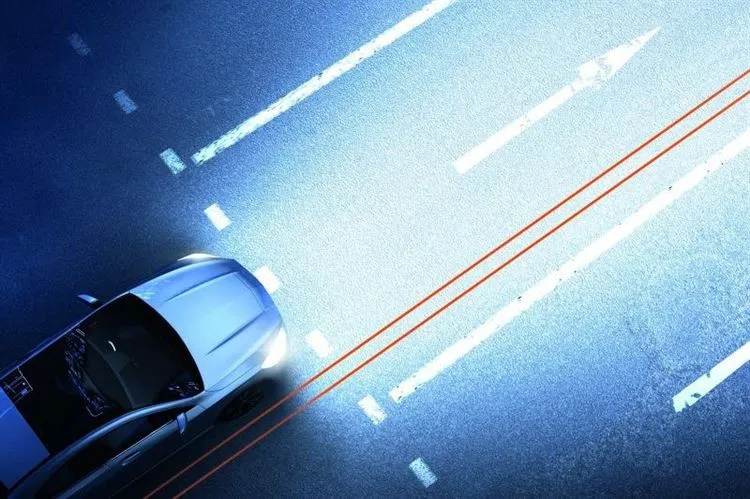
Percentage “+ XXX” is a rather complex complex value. The comparison is with the light of a certain conditional lamp, which is the minimum allowable according to safety standards, but the “plus” percentages are calculated by measurements at four specific points of the cut-off line of the light flux. Therefore, of course, “+ 100%” or “+ 150%” is not an increase in the brightness of the headlights by two or two and a half times, but an increase in the lighting effect exactly where it is usually not enough, at the cut-off line. Also, this increase affects the maximum range of the area illuminated by the headlights – these figures are indicated on the packaging of the lamps in meters, but it must be understood that this is not a guaranteed clear increase, but the numbers “TO xxx”. For this increase is individual and depends on the original design of the headlights of a particular car and on their technical condition – the quality of the reflector, the transparency of the glass, etc.
© OSRAM
Life time
The lifespan of light+ bulbs is an endless source of controversy buzzing in everything from garages to car forums. The main complaint about such lamps is “they burn out quickly”, and car owners, having purchased an expensive product, feel deceived… Why is this happening and is there a deception here?
The laws of physics are inexorable, and if the filament of a “light +” lamp is thinner and heated to a higher temperature, then it really lasts less than the filament of a similar conventional lamp – thicker and less hot. No other way!
The life of light+ lamps is about half that of classic design lamps, averaging approximately 250 hours versus 500 hours. This is usually not hidden and indicated on the packaging, but buyers rarely pay attention to such “little things”, which often leads to disappointment in the end…
You need to understand the following. Light+ bulbs are the ONLY way to make your headlights more efficient, legally and safely for your car and those around you. Well, in any case, the only budget one – for sure. For completely changing the headlights for halogen light to xenon ones, taken from a more expensive (or more recent in years) modification of your car model, is an extremely costly option. And if you really do a lot and often drive in the dark, then reducing the lamp life is a conscious trade-off in favor of increasing traffic safety and reducing driver fatigue. In the case of traditional halogen headlights, there is simply no ideal option – either improved illumination and slightly more frequent lamp changes with “light +”, or standard light and durability with conventional lamp design.
Also, “light +” is able to help out those who, even serviceable new headlights, did not initially have good light – well, they are just designed like that, it happens quite often in the budget car class… And even more so, they are useful for those who have headlights that are already old and worn out, with cloudy glasses and reflectors that have partially lost their specularity. If for some reason it is difficult to change such headlights, it is possible to return them to characteristics close to factory ones with just more efficient lamps.
Osram Night Breaker 200
Well, let's summarize the story about high-brightness lamps with the announcement of a new product – the most recently appeared most efficient lamps as part of OSRAM's efficiency improvement technology, Night Breaker 200. The increase in illumination for these lamps is a record + 200%.
“All of the above exhaustively characterizes the light + lamps of most manufacturers. The main thing is to initially understand their features and set your priorities correctly. And then the benefits of more efficient headlights for you will consciously outweigh the forced need for a slightly more frequent replacement of lamps. High-quality light will allow you to freely choose the speed limit, and not slow down on level ground due to poor illumination of the track and the roadside, “Osram technical specialist Artem Nuriakhmetov tells Kolesam.
“Well, nevertheless, I will briefly supplement this educational program with some individual features of OSRAM Night Breaker 200 lamps! In addition to two key technical solutions that distinguish them from conventional lamps (filament and bulb), the Night Breaker 200 uses many more small auxiliary technologies, which in total made it possible, with such a high increase in efficiency, to keep the lifespan of the Night Breaker 200 at the level of the previous generation of Night Breaker “.
This is an increased pressure and volume of halogen in the flask, which makes it possible to improve the regeneration of the tungsten filament (an effect long known for any halogens, and not just “light +” – the deposition of the evaporating metal of the filament back onto the filament). The filament has been made more resistant to vibration – as much as possible today for a thin filament operating at elevated temperatures. Another innovation – in addition to the usual halogen, xenon is added to the lamp bulb! No, of course, this lamp did not become a xenon lamp – a gas-discharge xenon lamp has a completely different design and principle of operation, but xenon in a halogen lamp, as it turned out, can be very useful! Xenon atoms are large in size, and, “enveloping” the filament, they do not allow the detached tungsten atoms to fly far from the base, accelerating the regeneration process and working as a kind of “gas heat insulator”,
Night Breaker 200 light is 20% whiter than standard halogen light – the color temperature is increased (up to 3700 Kelvin for Night Breaker 200 H7 lamps and 4050 Kelvin for Night Breaker 200 H4 lamps), which creates a more comfortable light for the eyes. And the range of the illuminated area has been increased by up to 150 meters (depending on the type and condition of the headlight, of course).
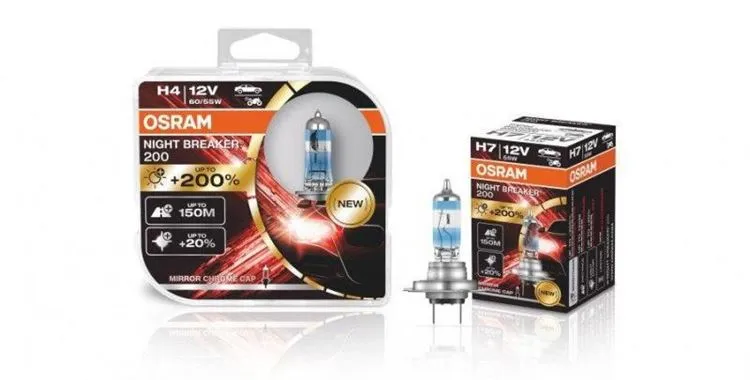
OSRAM Night Breaker 200 is available in the most popular sizes H4 and H7. And, by the way, they are reliably protected from fakes – these lamps in double plastic boxes are covered by OSRAM Trust's proprietary authentication system, which allows you to detect a fake even at the stage of purchase! To do this, we go to www.osram.ru/trust, enter the 7-digit code from the package in a special window and click “Check”. This is the first stage. In it, we receive confirmation of information about the product – the name of the model and product line. After that, the service gives you a second code – it should be on the lamp base. We compare the received code with the inscription on the lamp, and if everything matches, we have a 100% original!
