
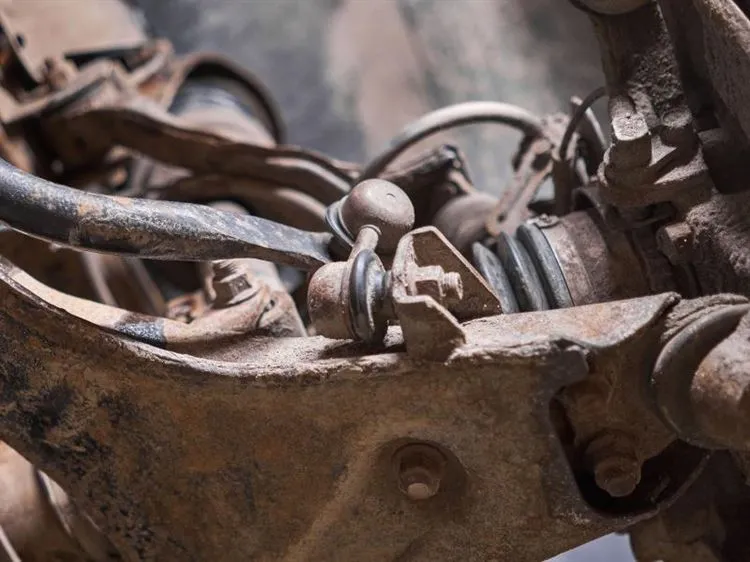
How to know when it’s time to change the stabilizer links
We often write something like “the stabilizer bar is a consumable” in materials about used cars. Surely you have come across such a phrase, for example, in the reviews of Boris Ignashin. He says this not because he does not consider the strut an expensive or important part, but because it is a fact: the stabilizer struts fail more often than other parts of the chassis, and their prices are usually low. Hence the attitude to them as consumables. However, this does not mean that this detail is unimportant. She is still so important, although if you wish, you can go without it at all. But it's better not to do that.
roll theory
The task of the stabilizer struts is to hold the stabilizer itself. Therefore, let's start with it.
It is logical that in a turn the car is forced to roll (its center of gravity is still located not at the point of contact of the wheels with the road, but much higher, so there is no escape from centrifugal force). Roll itself is not the most pleasant thing. And not because everyone in the cabin of a rocking car will quickly start to feel sick, but because during a roll the load on the inner and outer wheels with respect to the center of rotation of the wheel changes greatly. And this affects not so much comfort as handling. The anti-roll bar should solve this problem.
This is especially true for the most common MacPherson type front suspension. Theoretically, the camber angles of her wheels are constant, but just in a roll, with a large difference in the load on the wheels, the camber angle changes. It seems that nothing can be done about it – such a design feature, but the stabilizer still does it. If a roll occurs, the opposite ends of the stabilizer begin to move in opposite directions. In the middle part there is a moment that prevents the relative movement of the wheels. As a result, not only does the roll stop growing, but the load on the inner and outer wheels is more evenly distributed. So the stabilizer fully corresponds to the concept of genius: a very simple but effective piece of iron. Of course, there are also complex stabilizers, the stiffness of which is adjusted automatically or at the command of the computer, but that's another story. Today we are talking about the usual “stubs”.
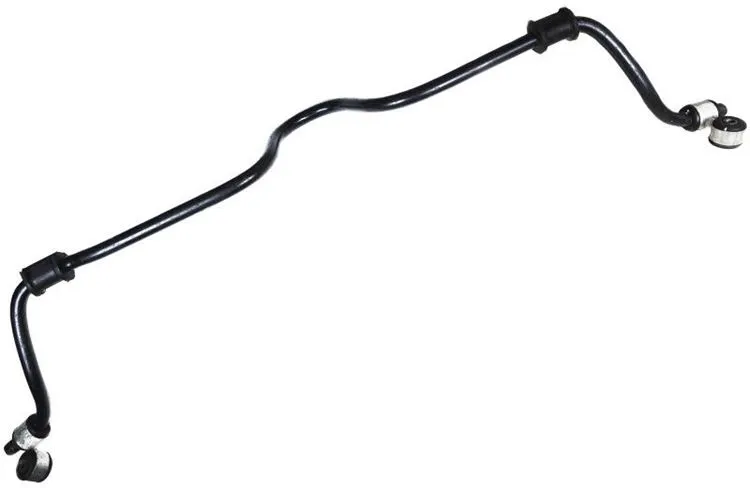
Stabilizer links are the parts that attach it to the body. Of course, it would be easier to weld it, but the stabilizer cannot be fixed. Its task is to move the ends to create a torque that would press the wheel that comes off back to the road. Therefore, he himself stands in the bushings (to rotate a little), and his racks have movable joints. Otherwise, they would simply break off, and the structure itself would not be able to work. Connections are different: with ball joints or with bushings. They may have a thread on one end, but there will definitely be something movable on the other. The most common mount is a ball joint. The thing is very suitable in its capabilities, but, unfortunately, not eternal. Especially in the case of a rack that constantly experiences variable loads. Over time, the ball joint begins to play, creak and thump. And this is inevitable.
Grease, boot, but not SHRUS
It is clear that it is this connection that eventually becomes the cause of the appearance of obscene sounds. And the design here is absolutely typical for many other automotive ball joints: a steel ball pin is in a plastic seat, all this is smeared with grease and covered with anther. Nothing new. There is something similar in the tie rod ends, and in the CV joints (except for the finger itself), and in many other places. The main advantage of such a connection is the low cost of construction.
Why is the rack falling apart? The first reason, of course, is due to the peculiarity of the operation of the rack. The stabilizer is constantly trying to compress it, then stretch it. And at the same time it turns a little. Of course, over time, the plastic grinds down, and the ball joint begins to creak (as, for example, the ball joint of the wheel – there is also a lot in common).
The second reason is the natural aging of the lubricant. There is nothing to explain here.
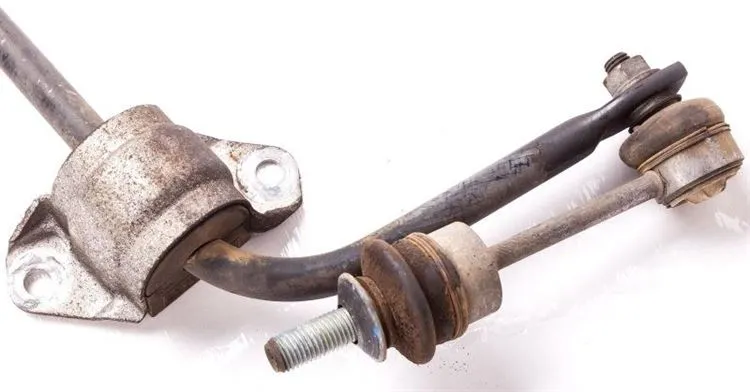
The third is a torn anther. The lubricant is washed out of the joint, but dust, sand and all the rest of the road dirt gets there instead.
The fourth reason is our roads, multiplied by the peculiarity of driving a car by some individuals. There is no such detail in the running gear of the car that would favor pits and potholes. And the stabilizer bar is no exception. Interestingly, we often kill them on purpose. For example, when we run over rails or speed bumps at an angle. This, of course, saves other parts that are more expensive, but significantly reduces the life of the stabilizer struts. Because they wear out the most under the diagonal load, which they try to compensate with all their might. By the way, this is why on some serious SUVs the stabilizer can be turned off: this allows you to increase the suspension travels limited by this particular stabilizer.
Of course, high-speed cornering also belongs to the same opera. On the one hand, a stabilizer with racks is needed for this, on the other hand, the load during such a maneuver is maximum. You just have to come to terms with this.
What and how?
Every owner who has driven a lot on his car knows how to recognize the wear of the stabilizer struts. They make such unique sounds that it is very difficult to confuse them with something else. But if you had to get into an unfamiliar car (for example, after buying it on the secondary market), you can get a little confused. Therefore, let me remind you how to understand that the racks will have to be changed.
I will say right away: it is quite difficult to determine the wear of the rack by the behavior of the machine. It is often said that the car begins to roll more strongly in corners, handling becomes worse, the car begins to scour on the track. In my opinion, this is not so simple and may be the result of a wide variety of breakdowns, so I would not rely on these signs. Moreover, there are more unambiguous sounds.
The stabilizer struts react most strongly to lateral loads (the stabilizer is not in vain called the anti-roll bar). Most often, they begin to creak and knock when trying to hang diagonally. If nothing knocks in the car, but a creak or even a knock is heard when driving through deep holes slowly, these are the stub racks. The sound is quite loud, but muffled. Its localization from inside the cabin is often difficult, but if you shake the car, the source will give itself out as a creak in the wheel area. The ball joint can also creak in a similar way, but usually it is quieter (if not completely gouged).

A good way to make sure that the source of the sound is correctly identified is to slowly drive through the speed bump twice. First, this must be done strictly perpendicular, then at an angle. If in the first case the chassis was silent, and in the second it creaked, these are definitely the stabilizer struts.
If there is a faithful comrade nearby, you can go the other way: turn the wheels to the side and grab the rack with your hand. A comrade (not only faithful, but also strong) must shake the car. Feel the backlash – change the rack. Serviceable racks should not play.
Another good method will help if only a creak is heard. You can try to spray on the spherical joint with a “vedeshka”. If the sound after this operation disappears or becomes quieter, then this is again a rack. By the way, the sound can disappear even for a week, so if it infuriates, but there is no time to change the racks yet, you can spend some time on the “Vedashka”.
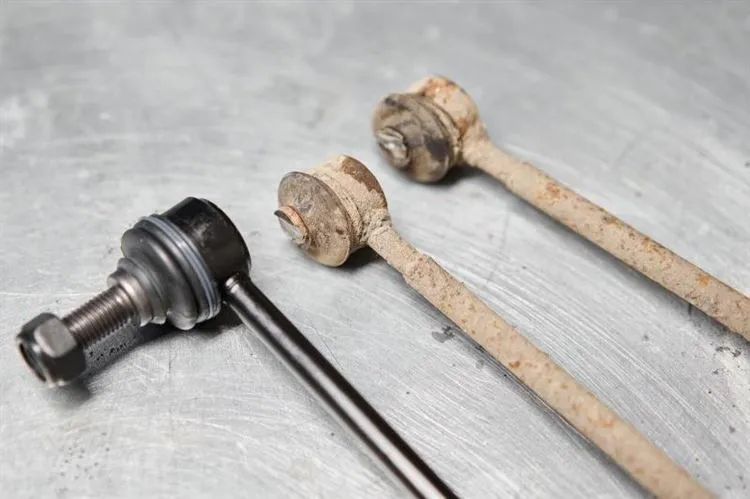
There is no big reason to be afraid of knocking racks. The car can drive without them at all (and without the stabilizer itself too). Worse, of course, but maybe. Racks break completely too rarely. More often they break in the thinnest and, accordingly, the weakest point of the rack rod. But this is also not scary, although the knock will drive you crazy. By the way, the stabilizer itself can also break. But this happens with very old cars, where, due to age, the stabilizer simply rots.
It's a pity, but the service life of the racks is really limited. Somewhere they serve in general for 20-30 thousand kilometers, somewhere they can serve even a hundred. In any case, at the first sounds that begin to be heard from under the bottom of the new car, the first thing to check is the racks – the part with the least resource.
And finally: the stabilizer bar is not a part that can only be installed with the original one. Usually there is a large selection of analogues that are in no way inferior to the original, but are much cheaper. And that's great.
