Railway crossing: where you can’t stand, what you can’t do and what you can lose your rights for
It goes without saying that a railroad crossing is a place of greater danger: accident posters on every second level and accident videos on the Internet that appear almost every day remember this. However, the rules here are sometimes violated even by those drivers who have not done so. And the fines for traffic violations are very severe. Let's remember all the nuances of what you can not do at a railway crossing, how to cross it correctly and what the violators risk.
It seems to be easy to deal with the passage of intersections: after all, there is a separate section 15 of the SDA, which regulates traffic on railway tracks. However, in practice, not everything that is important is contained in one section. Let's first remember how the intersection is marked, then find out what is forbidden to do at the intersection and in its vicinity.
How is a railroad crossing marked?
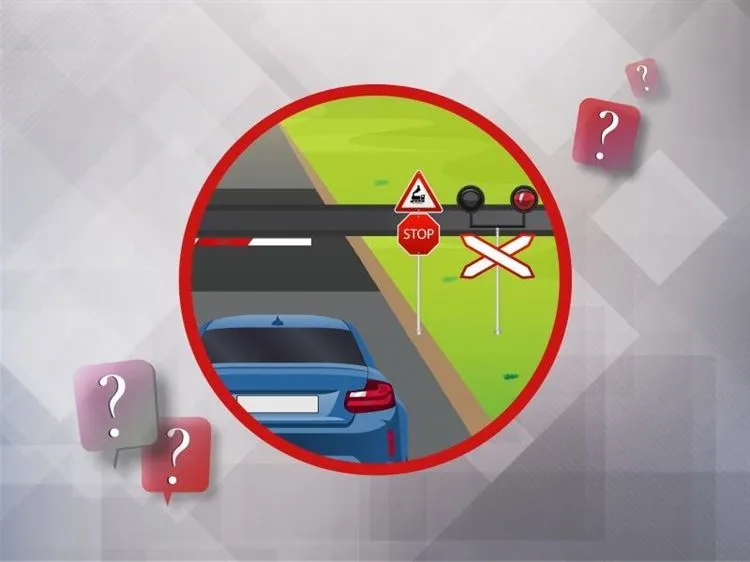
Everyone remembers the “locomotive, the fence and the red stripes”: everyone says that there is a railway ahead. However, it is worth understanding all this in more detail, especially with stripes – something important depends on them, as we will learn later.
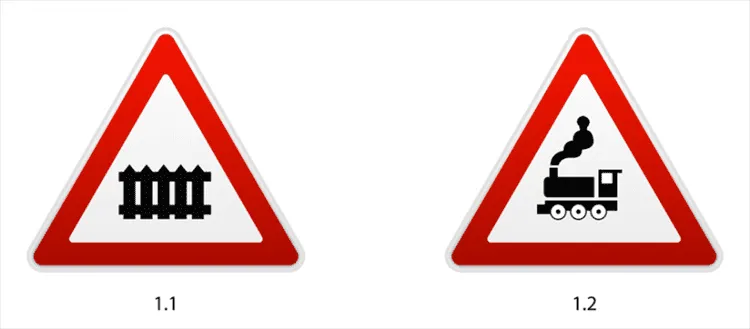
So, the railway crossing itself with and without a barrier is indicated by signs 1.1 and 1.2, respectively: the fence on the sign indicates the presence of a fence, and the locomotive indicates its absence.
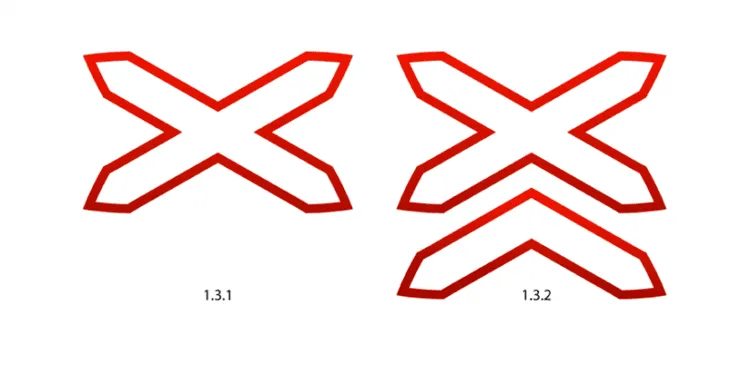
Under sign 1.2 are signs 1.3.1 or 1.3.2: they designate single-track and multi-track railways respectively. This is necessary so that drivers can more accurately plan their movement along the highway.
In addition, sign 2.5 “Continuous traffic is prohibited” can be installed at rarely used railway crossings. In this case, the driver, before crossing the railway crossing, should simply stop in front of the stop line or give a signal to make sure that the oncoming train is not moving.

In addition to crossing signs, there may be a traffic light for flashing red signs and a device for sounding the signal. Another option is a traffic light with a round white moon flashing signal. According to paragraph 6.16 of the SDA, a round sign with a flashing white moon located at a railway crossing allows vehicles to move through the intersection, and when the red and white signs with a flashing moon light are off, traffic is allowed, if not, it is a train (locomotive, wagon) approaching to the intersection).
Well, at the entrance to the crossing outside the settlements, signs 1.4.1-1.4.6 “Drive to the crossing” are installed. To understand the logic and order of their installation, you need to refer to GOST 52289. Firstly, it states that signs 1.4.1-1.4.3 are installed on the right side of the street, and signs 1.4.4-1.4.6 are installed on the left. The rules for installing signs are such that the number of lanes on the sign decreases as you approach the intersection: the sign 1.4.1 / 1.4.4 with three lanes is installed further, followed by 1.4.2 / 1.4.5 this and the sign 1.4.3 / 1.4. 6 with a traffic lane installed in the area of the railway crossing. In addition, GOST regulates the exact distance for installing signs: signs 1.4.1 / 1.4.4 are installed 150-300 meters before the start of movement, and 1.4.3 / 1.4.6 – 50-100 meters before the start of movement. These signs are often overlooked but in fact they play an important role. To understand this, you need to remember what is forbidden to do at the intersection and next to it.
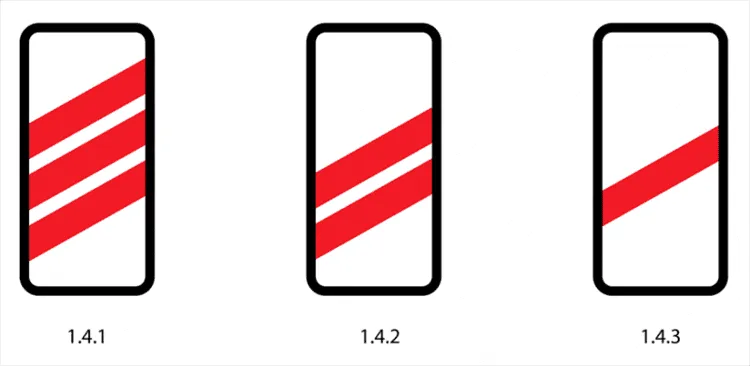
Signs 1.4.1-1.4.3 are installed on the right side of the road
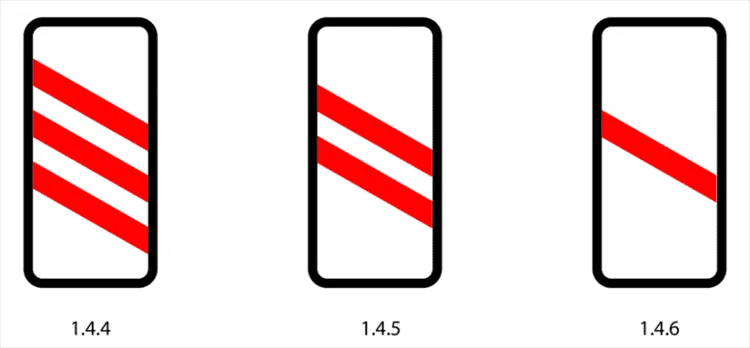
Signs 1.4.4–1.4.6 are installed on the left side of the road How to stop at a crossroads?
The rules for stopping before a closed crossing are specified in clause 15.4 of the SDA. According to it, in cases where movement through the crossing is prohibited, the driver must stop at the stop line, sign 2.5 or traffic lights, if there are none, no closer than 5 m from the barrier, and in the absence of the latter, no closer than 10 m from the nearest rail.
What can not be done at the railway crossing and its surroundings?
Most of the prohibitions relating to level crossings are contained in the relevant paragraph 15.3 of section 15 of the SDA. Let's talk about cars.
it is forbidden to enter the intersection when the barrier is closed or begins to close, regardless of the traffic light. That is, even if the traffic light is off, but the barrier is closed or closes, it is forbidden to cross the crossing.
it is forbidden to go to the intersection with a prohibiting traffic light, regardless of the position and presence of the barrier. This is also an important condition: often the barrier opens before the traffic light and sound signal go out, and many motorists believe that the opening of the barrier already allows them to move. In fact, this is not the case, and driving under an open barrier with a traffic light on is punished in the same way as driving around a closed barrier.
it is forbidden to go to the railway crossing with a prohibition sign by the conductor of the passage. The prohibition sign for accompanying persons is similar to the signs prohibiting traffic: the accompanying person looks at the driver with his chest or back with a stick, lantern or red flag raised above his head, or arms outstretched to the sides.
it is forbidden to go to the railway crossing if there is a traffic jam behind the crossing, which forces the driver to stop at the crossing. Even this obvious rule is often overlooked when the distance to the vehicle in front is not respected in heavy traffic. As a result, the car in front stops immediately after the intersection, and the driver who does not keep the distance is blocked at the intersection. So, before you cross the rails, you should let the car in front of you leave and make sure it leaves room to cross the intersection safely.
it is forbidden to go to the railway crossing if the train (locomotive, wagon) is approaching the crossing in sight. It should be understood that this rule works in any conditions: when the prohibiting traffic light is turned off, the barrier is open, and so on. Possible equipment malfunctions have not been eliminated, and the braking distance of a train weighing hundreds of tons is measured in kilometers. Therefore, an approaching train means an unconditional ban on crossing the intersection.
It is forbidden to go around cars that stop in front of the intersection and drive into the oncoming lane. This point is often violated even by particularly brisk and fearless drivers who go around everyone before the opening of the barrier or immediately after it. However, such maneuvering according to the rules is strictly prohibited by clause 15.3 of the SDA.
It is forbidden to open the barrier without permission. Comments are unnecessary here and the ban is aimed at those who are desperately trying to “catch” the next light by missing the wrong one (i.e. red).
U-turns at railway crossings are prohibited. This paragraph opens a list of prohibitions indicated not in paragraph 15.3, but in the rules of the road in general – these conditions are sometimes forgotten, since they are not collected in one place, like others. For example, when we learned where U-turns were prohibited, we made it clear that clause 8.11 also contained level crossings.
overtaking is prohibited at railway crossings and less than 100 meters in front of them. We also talked about this in the detailed material on overtaking: this is prohibited by clause 11.4 of the SDA. And here the signs 1.4.1-1.4.6 “Approaching the crossing”, which we spoke about above, come to the fore. Recall that signs 1.4.1 / 1.4.4 with three lanes are installed 150-300 meters before the intersection, and 1.4.3 / 1.4.6 with one lane – 50-100 meters before the intersection. That is, it is not worth starting overtaking already when passing the mark 1.4.1 / 1.4.4, and the started overtaking should be completed as soon as possible. Well, hitting the next lane after the 1.4.3/1.4.6 mark is already a guaranteed foul.
parking at railroad crossings is prohibited. This is spelled out in clause 12.4 of the SDA, and we talked about this in the article on where it is forbidden to stop, and in general the essence is quite obvious: it is dangerous to stop on the rails.
Parking is prohibited at railroad crossings and less than 50 meters from railroad crossings. The requirement of paragraph 12.5 to prohibit parking on the tracks does not need comments, however, not all drivers remember that parking is prohibited even at a distance of less than 50 meters from the intersection on both sides of the road.
What is the fine for those who break the rules at the railroad crossings?
The fine for violation of the rules of movement on railway tracks is regulated by Article 12.10 of the Code of Administrative Offenses.
Part 1 of Article 12.10 provides for punishment for the following violations:
-
railroad crossing outside the railroad crossing;
-
leaving a railway crossing with a closed or closing barrier or with a prohibition sign from a traffic light or a passing agent;
-
stop or stop at a railway crossing;
-
crossing an unregulated railway crossing if a train (locomotive, trolleybus) is approaching the crossing in sight).
Any of the above violations entails the imposition of an administrative fine in the amount of 5,000 conventional units or deprivation of the right to drive vehicles for a period of 3 to 6 months.
At the same time, the repeated commission of an offense from the above list in accordance with part 3 of Article 12.10 entails the deprivation of the right to drive vehicles for a period of 1 year.
So, part 2 of article 12.10 regulates fines for violations not specified in part 1. Only a monetary penalty is provided for them: “violation of the rules for passing railway crossings, with the exception of cases provided for in paragraph 1 of article this article provides for the imposition of an administrative penalty in the amount of 5,000 conditional units.
