
Charge car battery voltage
Misuse of the battery can quickly degrade performance. To avoid this, it is necessary to periodically clean it from dust and dirt, this will reduce losses from self-discharge, and to maintain a certain density filled inside the electrolyte. In addition, every driver should be able to measure the battery voltage using a special table. This is what we will discuss in this article.
- 1 General information
- 2 Check upon purchase
- 3 inspection during operation
- 4 Relationship of electrolyte density to climatic areas
general information
The main functions of the vehicle are to scroll the starter when starting the engine and operating electrical equipment when the generator is turned off or when the voltage in the on-board network decreases. Inside the battery car there are six electrodes connected in series. They are made from a set of lead plates placed in a special liquid – an electrolyte consisting of sulfuric acid and distilled water.
They produce two types of batteries: maintenance-free and maintenance. The first works on the principle of set and forget. Their design has resulted in a small percentage of water boiling out of the electrolyte and an increased volume that lasts the entire life of the electrolyte. The second type of battery requires periodic maintenance, so it is advisable to know their structure.
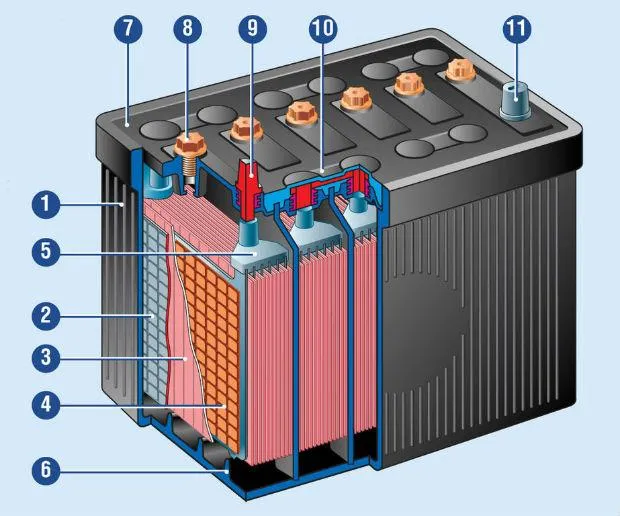
Battery maintenance consists of the following elements:
- chemically resistant insulating housing;
- plates with a negative charge;
- Inter-dielectric (separator);
- plates with a positive charge;
- the main role of the electrode (baretka) is also the stabilizer of the position of the plates;
- accent (prism directory);
- battery cover;
- filling hole plug;
- positive terminal;
- bridge between electrodes;
- negative terminal.
Check when buying
There can be several complementary methods to determine battery charge. The load plug measures the current at the terminals. A hydrometer will help you find out the density of the electrolyte. But the fastest and most common way is to measure the voltage at the terminals. It is advisable to use a device that detects a few hundredths of a volt. Voltage testing is done by connecting the probes to the battery terminals.
the current GOST R 53165-2008 for lead starter batteries regulates the rated voltage at the terminals under a break of 12.7 – 12.9 volts after a daily exposure from the date of manufacture and at an air temperature of 25 ° C. With these parameters, the battery is shipped from the factory. If, when checking the voltage before buying, the reading is less than 12.6 volts, indicating a low density of the electrolyte due to long-term storage. This battery requires immediate charging.
The table below shows the dependence of the car battery charge, the value of the measured voltage.
Note: the current GOST sets the voltage on each element to at least 2.1 volts, in general, it turns out that the battery is 12.6 volts. In some European countries, there is another criterion by which this figure has risen to 13.2 volts, which corresponds to 2.2 volts per specific part.
Check during operation
During operation, it is necessary to periodically check the condition of the battery. Here we must take into account the fact that if you kill the engine and immediately take measurements, the result is always the same – the battery is good. For reliability, you need to measure at 6-7 hours after stopping the engine. This is due to the fact that during the operation of the generator, the electrolyte inside the battery heats up and increases its density, increasing the voltage at its terminals.
Also, if the battery is not new and has been working for several years, it has a certain amount of current discharge that will be compensated by charging the alternator. To reduce the natural loss of ability to keep the battery clean. In the presence of electrolyte traces and other wet contaminants, discharge current may flow from the positive terminal to the vehicle body.
Another point is the battery connected to the on-board network, which, even when the ignition is turned off, consumes a certain amount of electricity (radio, alarm, etc.). Thus, you must remove the ground terminal from the body to minus before measuring, otherwise there will be some errors.
Density of electrolyte connection with climatic region
The nominal charge level of a vehicle's battery also depends on the season and climatic region in which the vehicle is operated. Our country is a huge territory with large temperature differences in different parts of the country. Batteries must take this into account during operation.
Even if the vehicle's power supply is installed, the eye-indicator should not be based on its readings. The presence of such a diagnostic tool is intended only for preliminary testing and often, when the decrease in density due to mechanical damage, its color is not changed.
The battery is one of the most important elements of the power supply system in the car and hardly anyone wants to deal with the problem of discharging it at the most inopportune moment. To prevent this from happening, we recommend that you check the voltage every two weeks.
