

Consumption 2 l / 100 km: Aerocivic from the 2000s
A video has been added to Jay Drone's YouTube channel that captures the current state of Honda Civic's original AeroCivic customization. Video at the end of the article, but believe me, it's more interesting to read the text first.
A unique idea of its kind was put into practice by Mike Turner in the second half of the 2000s. The latter was aimed at reducing fuel consumption by changing the flow around the body. The current owner of the modification also commented on the video.
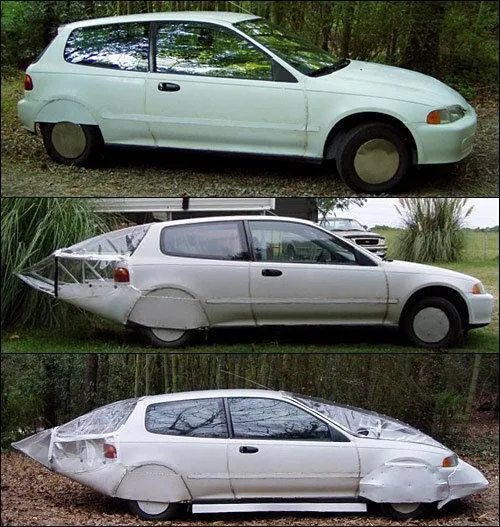
The enthusiast wanted to reduce aerodynamic drag to the maximum. The test subject in the experiment was a 1992 Honda Civic hatchback. By the time the test started, the Japanese passenger car had reached the age of 15. Over the years, she has traveled a distance equivalent to 560 thousand km.
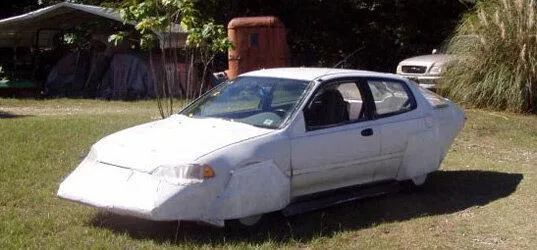
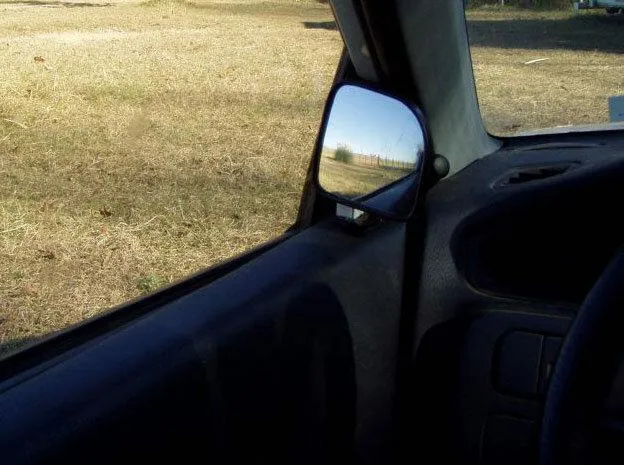
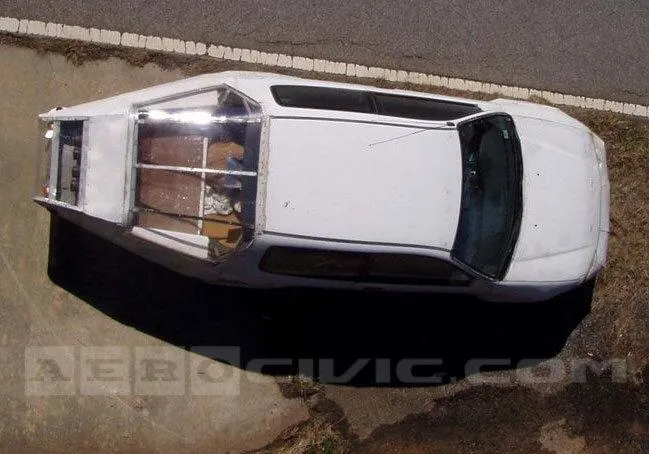
Turner made body parts himself: plates for the bottom, hiding the wheel arches of the canvas, a fairing for the front side of the car and a tail with a glass insert for the rear. The master installed the side mirrors in the cabin, and equipped the “wipers” with deflectors.
According to Mike, when developing the fairings, he relied on the techniques that engineers used to create such experimental machines. The basis of the new body components is an aluminum frame and materials that are used in the design of radio-controlled aircraft.
A modified car needs 2.5-3.6 liters of fuel to cover a 100-kilometer distance. More accurate consumption depends on the speed of movement. After tuning, the appetite decreased significantly, given that the consumption declared by the car factory for the same Civic, only new, is 5-6 liters.
The craftsman said that he achieved a flow around the body with the same level of drag as that of professional concept cars. Turner noted that he spent only $400 on new parts. He also said how long it took him to transform the “Japanese” – about 250 hours.
Subsequently, on a run of 820 thousand km, the author of the project replaced the internal combustion engine with an alternative engine that can operate on a lean mixture. As a result, fuel savings have become even greater. So, for a 100-kilometer distance, approximately 2 liters began to go. Mike achieved this indicator in 2009.
In those years, the owner of AeroSivic did not leave the halo of glory. Several articles from well-known automotive magazines have been published about the success of the experimenter. The designer was interviewed. By the fall of 2011, according to the tester, savings on gasoline reached almost $5.3 thousand.

If you carefully watch the video, you will notice that the modified car is in poor condition. In the comments to the video, a certain Austin Perdue said that he bought the AeroCivic from Turner, because. the latter, already retired, is unable to pay due attention to the project. The new owner announced his desire to breathe new life into the worn-out car.
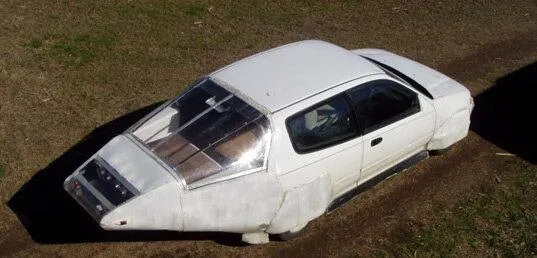
According to Mike's calculations, the AeroCivic's drag coefficient is less than 0.25. Currently, the record among conveyor vehicles belongs to Mercedes-Benz EQS – 0.20. If we talk about fuel appetites, then the Volkswagen XL1 claims to be the leader, fitting into 2 liters per 100 km. However, the XL1 is not so much a production car as an experimental one.
