
Unknown miniature cars in World War II: light and super light cars
On the eve of the world war, as opposed to the development of mass army jeeps and special vehicles, many foreign companies began to feverishly create all kinds of light, inexpensive and inconspicuous wheeled vehicles for reconnaissance and patrolling, which in the end, for the most part, turned out to be unknown and forgotten.
Strange and boundless beginning
In the United States in the 1930s, American Austin, a branch of the famous British company Austin, was developing unusual military vehicles. This unique and unusual product included a primitive 15-horsepower fighting vehicle with balloon tires and an anti-aircraft gun with three Browning heavy machine guns.
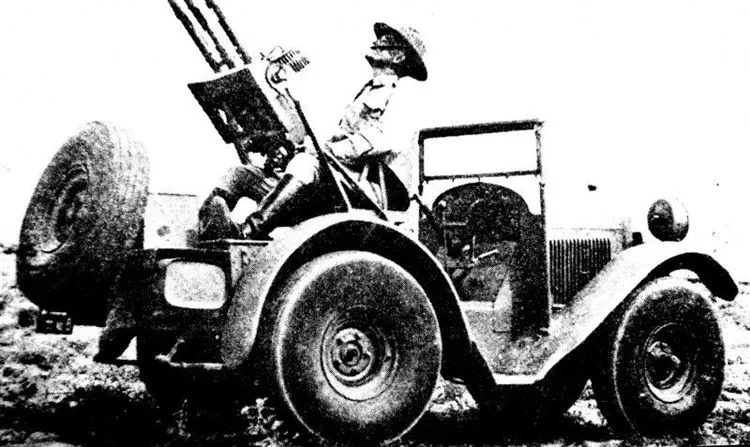
Decorative car American Austin on pneumatic tires. 1933
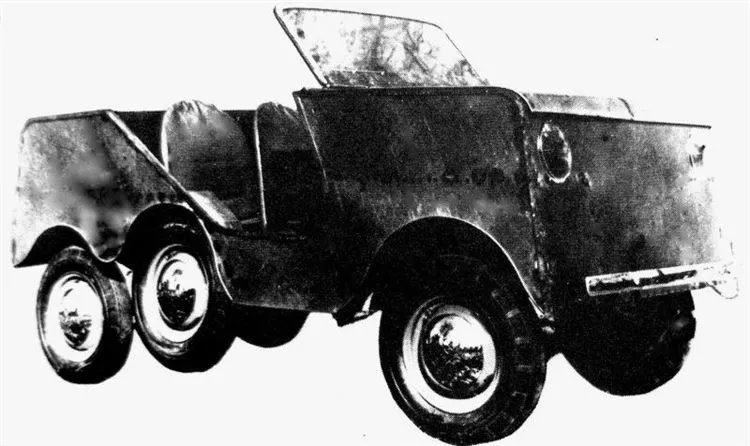
Complex installation of a combat all-terrain vehicle with six wheels. 1935
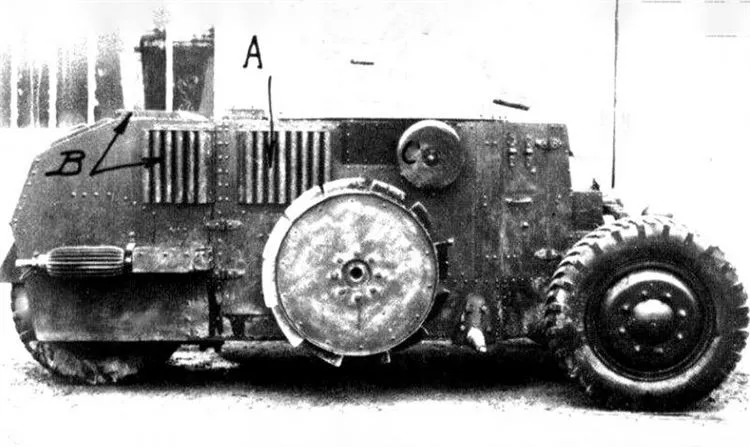
The French company Somua fought for the patency of army vehicles by installing front steered wheels, a pair of dual rear drive wheels and two steel side drums with sharp side lugs on their Gendron all-terrain vehicles.
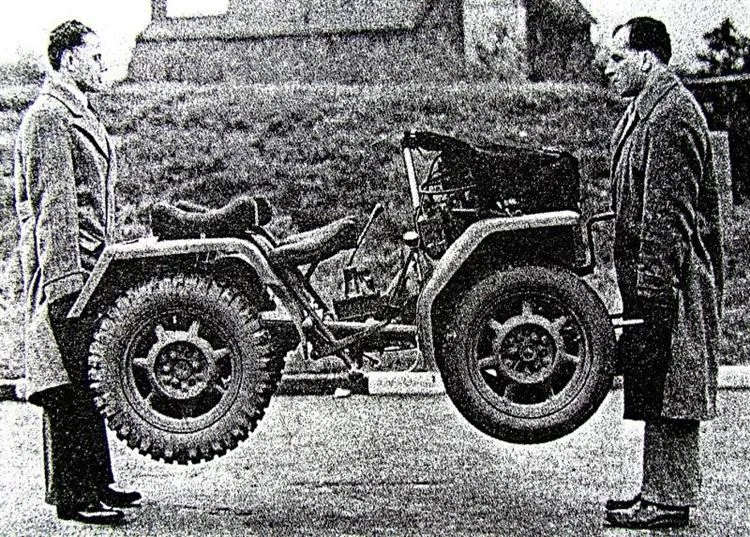
Crosley made a powerful contribution by building an unusual three-wheeled vehicle with two rows of seats and a compartment for ammunition. It contained two rear driving wheels from an ordinary passenger car, and on the highway the third pair of wheels was lifted by means of side lifts.
American all-terrain vehicle Crosley with lifting wheels of the middle axle. 1941
Military motorcycles and carts for lying
Despite the large fleet of military three-wheeled motorcycles from different countries, which are not included in our subject, the Belgian five-seater FN Tricar with a two-stroke 22-horsepower air-cooled engine and a rear drive axle from a passenger car on a spring suspension with reverse has earned the greatest fame.
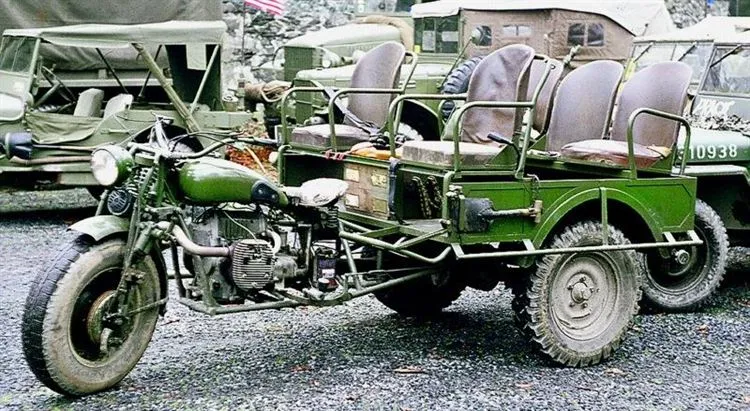
Unique motorcycle chassis from Belgium, assembled in 330 pieces. 1938-1939
In America, the weapon carrier created by Captain Robert Howie was considered an ultra-light machine, which for its low landing received the nickname Howie Belly – Flopper – “belly slap”. In such a motor cart with a rear 15-horsepower Austin engine and extremely low ground clearance, one or two people, a machine gun, and even a 37-mm cannon could fit lying down.
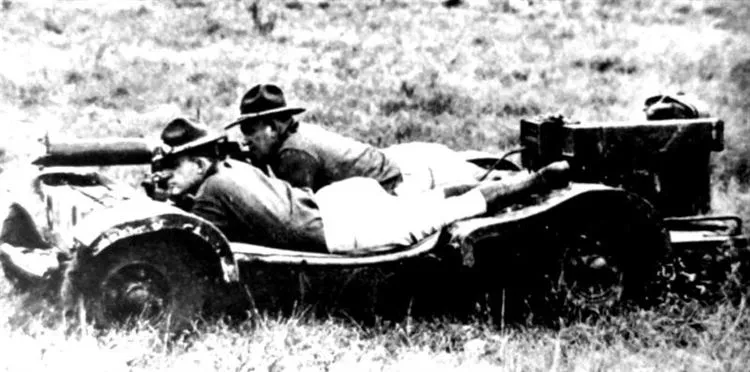
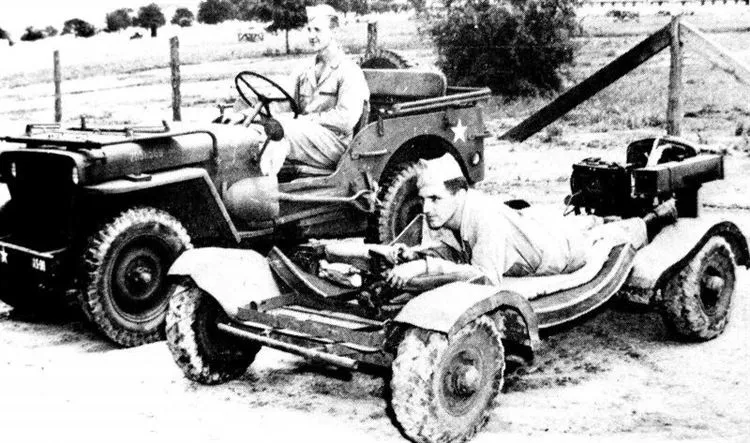
Revolutionary ultralight cart, nicknamed “bellyslap”. 1936-1937
It is little known that in February 1936, on the platform of an unfinished Volkswagen passenger car, designer Ferdinand Porsche assembled a low-profile two-seat Volkswagen 30 prototype (Porsche 30 or V30) with a machine gun and free-wheeling side spare wheels.
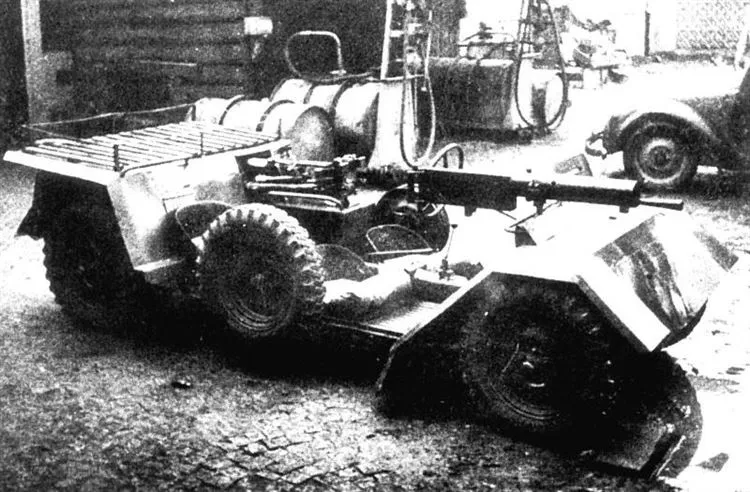
Cart Ferdinand Porsche in the version of the two-seat combat vehicle “Porsche-30”. 1937
Strict Englishmen of high economy
For the delivery of small and medium-sized transport aircraft, the British company Swallow Sport (SS) produced motorcycle sidecars, but in 1943 it built the only ultralight microcar SS – VA with a rear air-cooled JAP V2 motorcycle engine and chain wheel drive.
Ultralight Standard car with two motorcycle saddles and three passengers. 1943
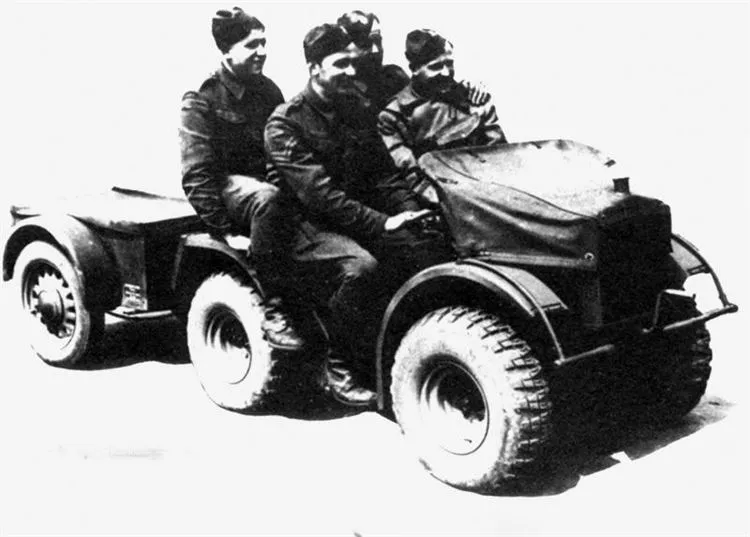
Miniature airborne landing cart Standard JAB with a mini-trailer (4×2). 1944
By the end of the war, Standard had assembled several compact four-seat utility vehicles, including a rear-wheel drive Jungle Bug and a four-wheel drive airborne JAB with Spitfire fighter wheels and a front-mounted one-litre 28-horsepower engine.
Failed US special jeep idea
The idea of miniaturization of one or two army all-wheel drive vehicles of unconventional design and appearance appeared with the first volleys of the war, when it was believed that they “could be carried on hand.” Such rare ultra-light cars with canvas fenders and open luggage boxes were usually built in several copies so as not to exceed the cost limit of the most common cheap cars.
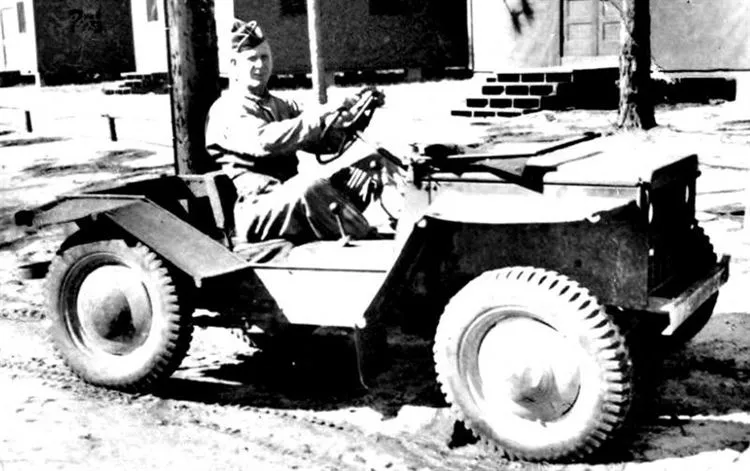
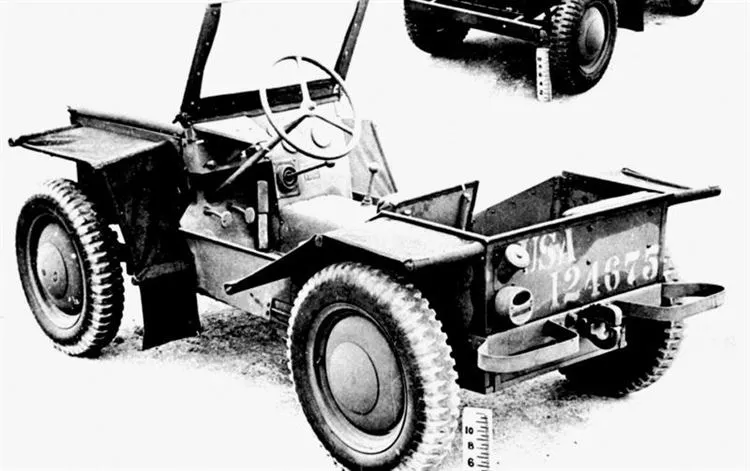
The simplest Crosley Pup traveling cars without unnecessary details. 1942-1943
The most common was the Crosley Pup (“Puppy”) minijeep, which looked like a damaged mechanical toy. It was equipped with a two-cylinder boxer air-cooled engine of 13.5 forces and a three-speed gearbox on quarter-elliptical springs.
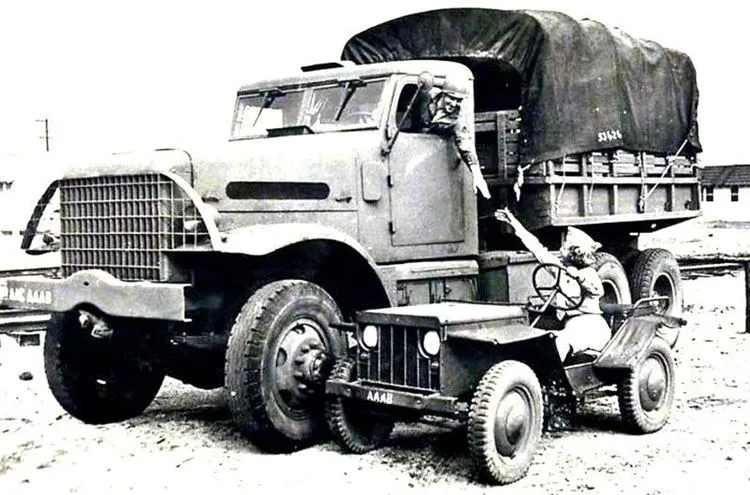
An embellished Crosley Pup car compared to a White-666 truck. 1943
Cars with a height of about 90 centimeters in different versions weighed 400-500 kg and reached speeds of up to 72 km / h. The Ordnance Department immediately ordered 36 microjeeps from Crosley.
Chevrolet has developed an example with an extended rounded hood, a central tubular spine frame and transverse leaf springs. Under the hood fit a motorcycle 750 cc air-cooled V2 engine with 20.5 forces.
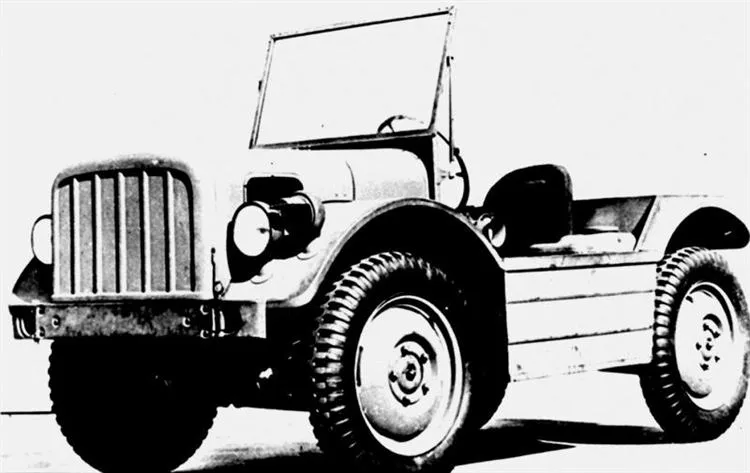
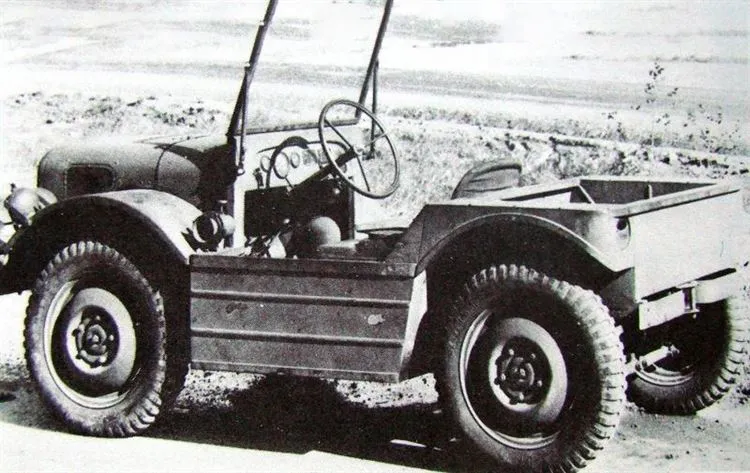
Quite an attractive and roomy Chevrolet trial microcar. 1942
At the shipbuilding corporation Kaiser Industries, six prototypes were assembled with different units and wheelbase options, equipped with an X-shaped spar frame and independent spring suspension of all wheels. The most successful version of the Kaiser -1160 received a four-cylinder Continental engine with a power of 42-52 hp.
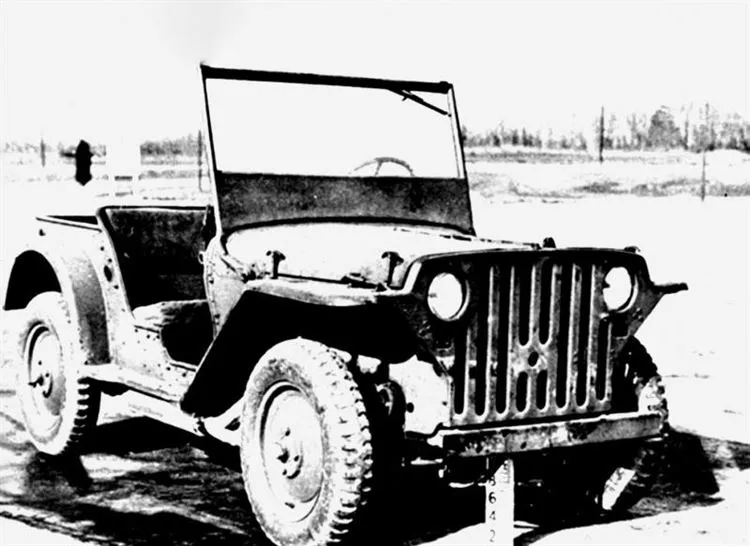
Model Kaiser-1160 with cladding reminiscent of elements and parts of mass-produced jeeps. 1943
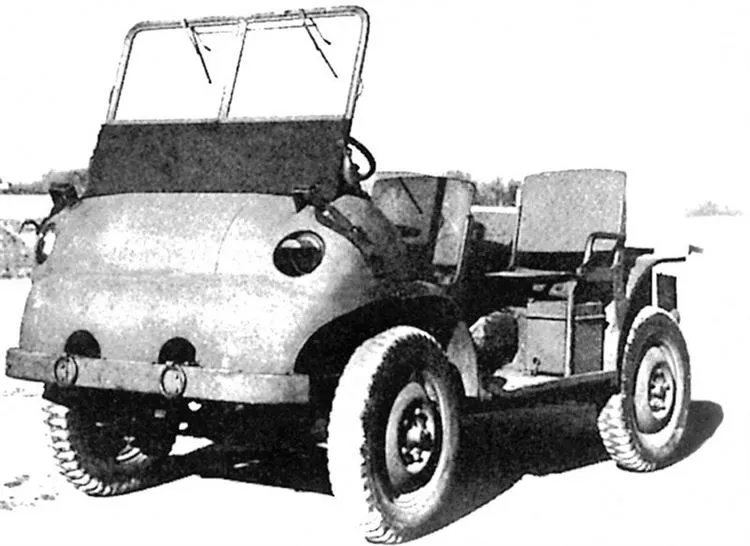
Perspective cabover mini-all-terrain vehicle Willys Air Cooled. 1943
The original four-seater Willys Air Cooled microjeep with a front fairing of aluminum shroud looked revolutionary. A Harley Davidson boxer two-cylinder motorcycle 24-horsepower air-cooled engine was located between the front and rear seats, and the suspension of all wheels was made independent.
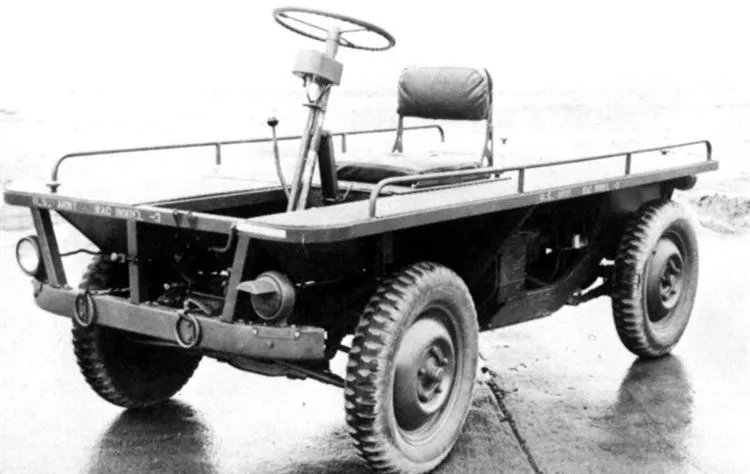
Compact army motor truck Willys WAC-3 with a cargo platform. 1944
The first dedicated ultra-light airborne transport cart Willys WAC -3 with a 24-horsepower air-cooled engine, a central helm position, a folding steering column and a peripheral cargo platform.
Passenger mini-cars at the local bridgehead
During the course of hostilities, numerous fleets of simple and cheap specialized cars did not differ much from the products of other manufacturers. In the British realm, Morris was the leader in this area, producing small cars, Wasp four-wheel drive staff cars and pickup truck families.
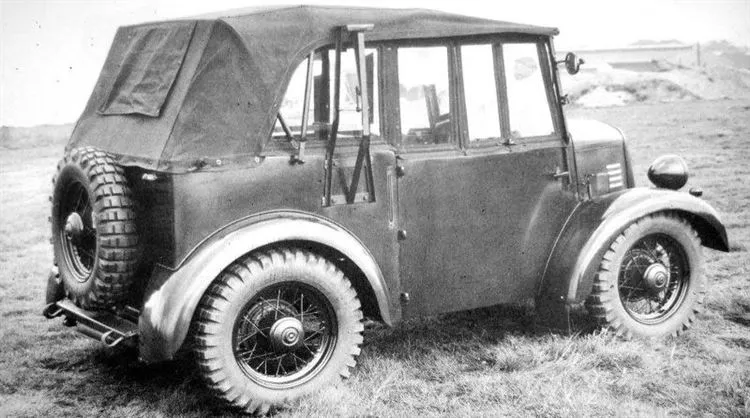
Morris Wasp compact staff vehicle (4×4) with an additional gearbox in the transmission. 1937
Japan has produced about five thousand of its own multi-purpose jeeps Kurogane – “Steel” (4×4) with sports-style bodies. They mounted a 33-horsepower V2 engine with aluminum block heads and a dry sump, made in a single crankcase with a three-speed gearbox.
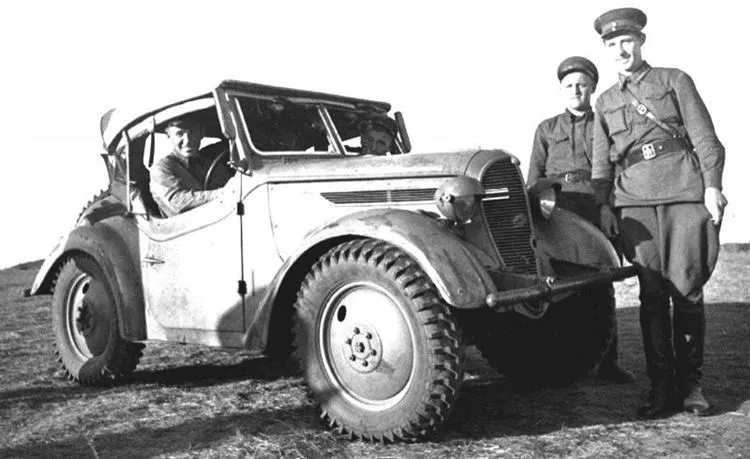
Soviet soldiers in a light Japanese jeep “Kurogan Type 95” at the battlefield near the Khalkhin Gol River. 1939
Unknown french jeeps
In the pre-war years, small French firms reported on search work and the creation of various types of light cars, but in reality, almost no one saw French jeeps. In 1939, the development of a new family of minicars was entrusted to Laffly.
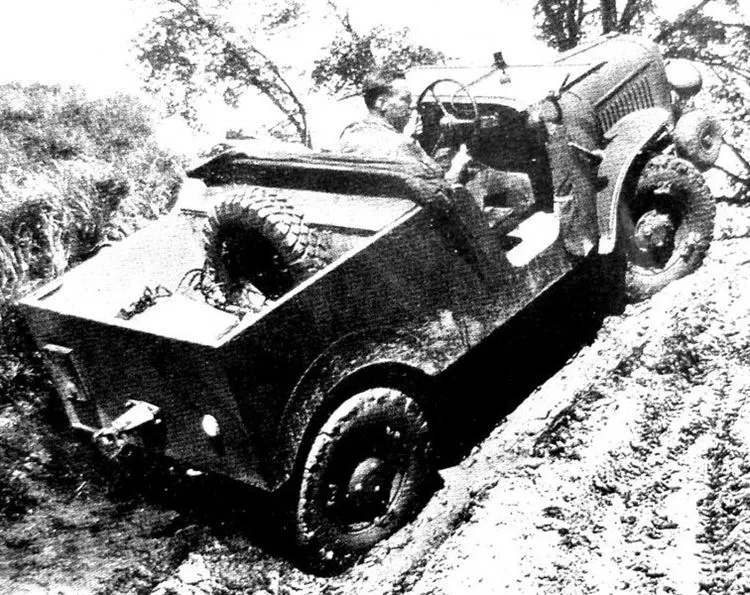
She planned to hold a demonstration of three types of Laffly vehicles at once: V 10 M – a multi-purpose transport option, a V 10 R reconnaissance and communications vehicle with various add-ons, and a passenger V 10 CM with seats in the back. They were supposed to use new design solutions: wheel gears, all steered wheels, torsion bar suspension, lightening and reducing the mass of the chassis.
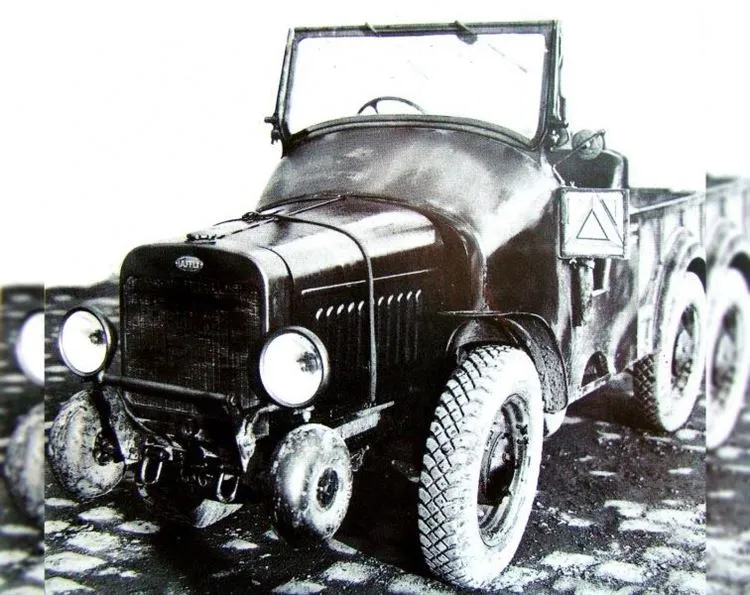
French jeep Laffly V10M with a shortened body. 1939
Passenger version of the V10CM with benches in the back. 1940
The first to appear were the V10M and V10R models with a 33-horsepower Amilcar engine, and then until May 1940, the 38-horsepower Hotchkiss engine was used throughout the batch. With the approach of World War II, the state order for 500 cars was canceled, since only one V10M car actually participated in the tests, which each time was simply “dressed up” for the next “performances”.
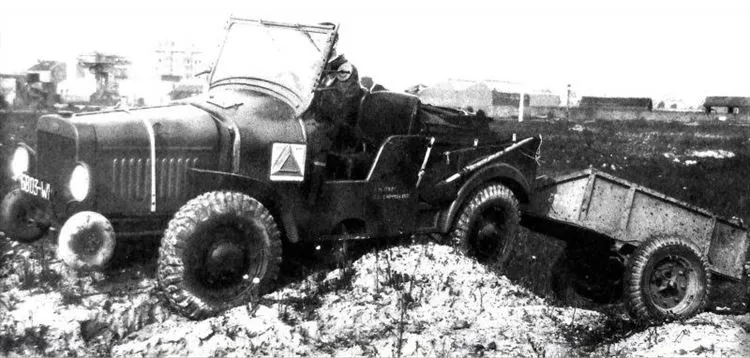
Perspective jeep Laffly V10M with a passenger body and a trailer. May 1940
Austrian joy
One of the simplest and lightest vehicles of the Austrian army was recognized as a one-ton cabover vehicle ADTK (4´2) of the Austro – Daimler corporation. In its rear compartment there were six seats for soldiers, a 20-horsepower air-cooled engine, machine guns and even… a compact mobile kitchen.
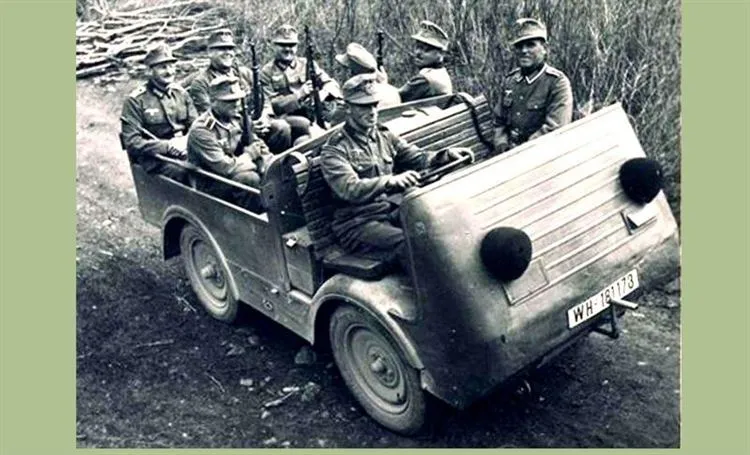
Lightweight ADTK machine for towing trailers, field kitchens and cannons. 1936-1939
OM – heroic all-terrain vehicles of Italy (1932-1939)
The short Italian automotive abbreviation OM was part of the Milanese engineering company Officine Meccaniche, founded in 1899 and joined the production of cars at the beginning of the 20th century.
As for lightweight military trucks with all driving and steerable wheels, Benito Mussolini could not do without competitions and instructions. So, in 1932, the Italian military department began to produce a small family of five almost identical and unified vehicles that retained right-hand controls. Their main task was to transport units of Italian mountain shooters with ammunition and weapons.
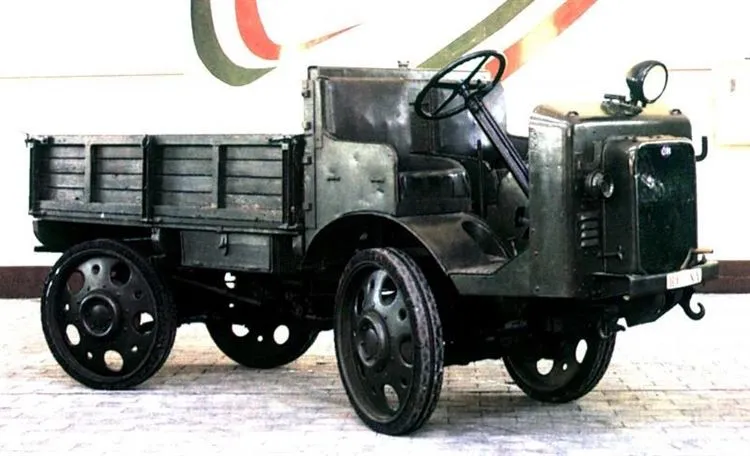
Compact mining truck OM-32 with all-wheel steering and massive rubber tires. 1932
The first in this row was the narrow, tall and compact truck OM-32 – the so-called mountain car Autocarretta da Montagna (“Autocarretta da Montagna”), which was created by engineer Giuliano Cesare Cappa from the military-industrial company Ansaldo. The car with a wheelbase of two meters and a ground clearance of 450 mm had an open double cab, a shortened body with folding sides for the transport of goods and a lighting headlight on the hood.
The first model housed a four-cylinder gasoline 20-horsepower air-cooled engine with a volume of 1616 “cubes”. The transmission included a four-speed center-mounted gearbox with a two-stage gearbox that transmitted torque by oscillating shafts to each wheel with disc brakes and massive rubber tires.
The development of the next model OM-35 was promoted by increasing the engine power to 23 hp. with the preservation of the chassis with a high-sided body for the transport of multi-purpose cargo. A year later, the OM-36M variant was created with wooden seats in the back for transporting personnel, 18-inch wheels with pneumatic tires and a spare wheel on the rear side.
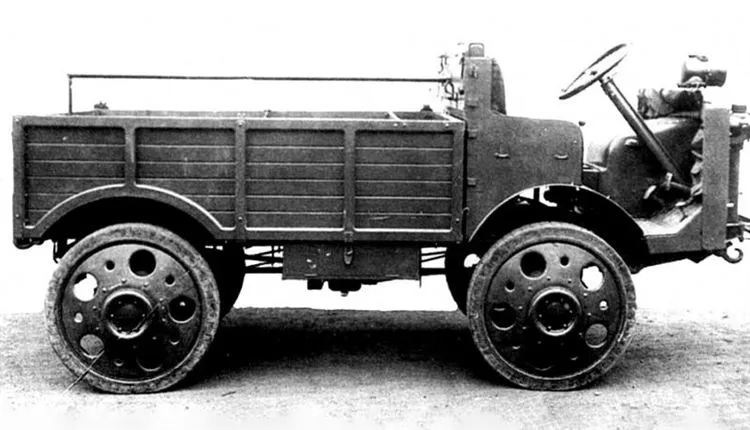
Multi-purpose 23-horsepower truck OM-35 of the first modernization
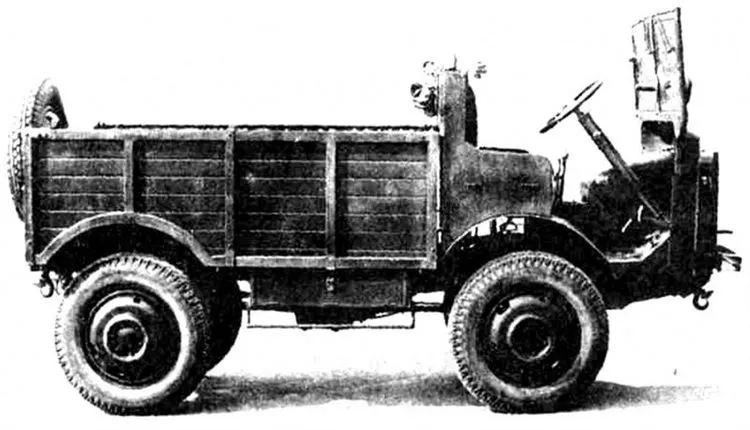
Modified version of OM-36M on wheels with pneumatic tires
The most progressive were the so-called “army passenger cars” OM-36P with special open bodies with four transverse aisles, through which every soldier, driver or commander (11 people in total) could easily leave the car or take their seats again.
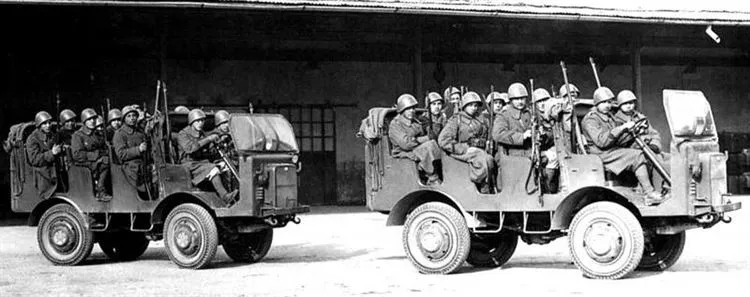
Mountain vehicles model OM-36R for the delivery of nine soldiers in each vehicle
In a reinforced version, the OM-36 DM combat vehicle with the same body was equipped with one or two machine guns mounted on the upper back of one of the front seats. In this design, the crew was reduced to 7-10 soldiers.
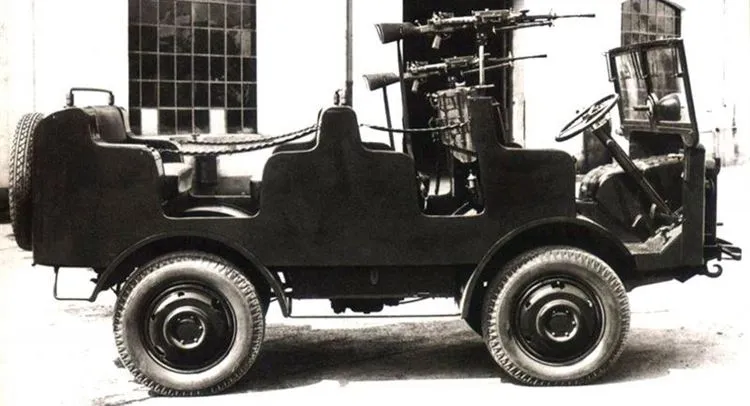
The combat truck OM-36DM with the same body differed in the number of machine guns on the rack
The only new feature on the latest OM-37 model was a gearbox with a built-in self-locking differential.
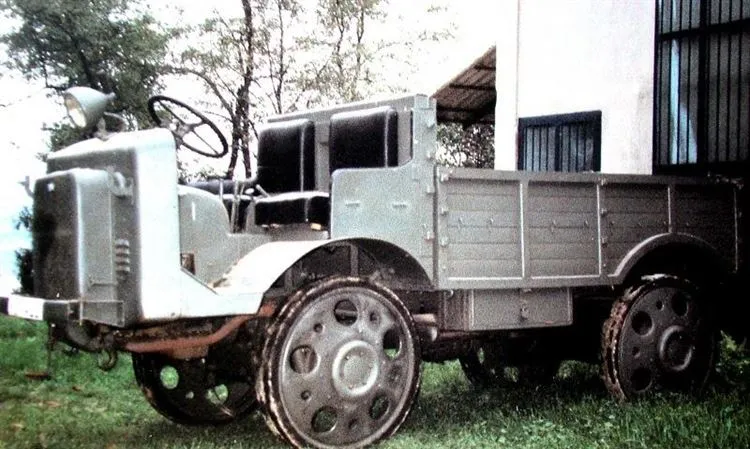
As of 1939, the machines of the OM-32 series, which developed a speed of 23-34 km / h, were in service with Italy, there were 2.7 thousand
The title photo shows an army 23-horsepower OM-35 car for Italian mountain shooters, preserved in the Belgian Victory Memorial Museum.
