
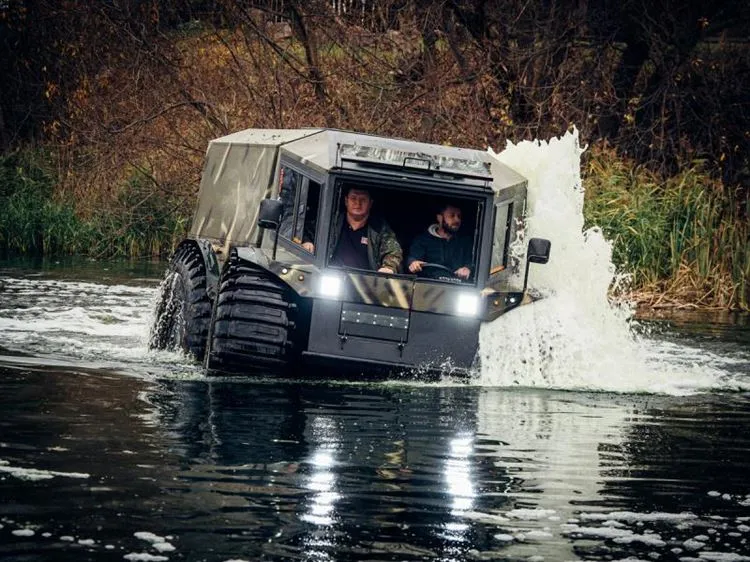
What Shatun is capable of. Test drive of a wheeled all-terrain vehicle
One day, even prepared off-road vehicles become scarce to go where they have not been before. Then the time comes for real all-terrain vehicles and the OffRoadClub.Ru portal has been looking for the best option for more than a year, so that both in fire, and in water, and on a trip. Travel, not on an “expedition” with travel wallets.
We tried the caterpillar technique and were not delighted. Suitable, but not for our goals, which we have set ourselves. Now it's time for wheeled vehicles. “Sherp” immediately comes to mind, but it is too small for us, so we look at the “Shatun” snow and swamp vehicle. About him and will be discussed.
Constructive
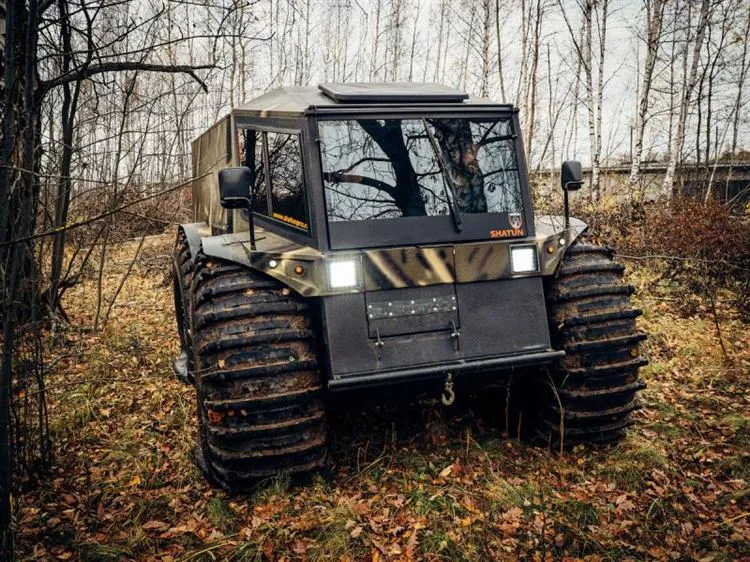
The connecting rod is primarily an articulated all-terrain vehicle with a breaking frame. The frame breaks only in one horizontal plane. We don't know whether this is good or bad, since we have little personal experience in operating such vehicles, and we don’t want to shine with theory. The manufacturer claims that such a design “holds” better when overcoming wetlands.
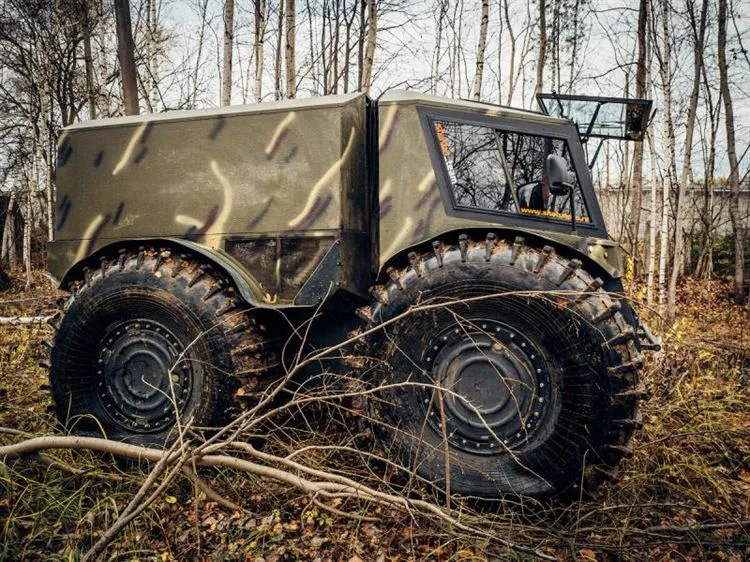
The body is made in the form of a “boat”, the parts of which are interconnected by special “channels” of control. When launching, the connecting rod will not sink. Buoyancy is added by huge wheels, exceeding the size of the wheels of the famous Sherpa, looming literally at every off-road event.
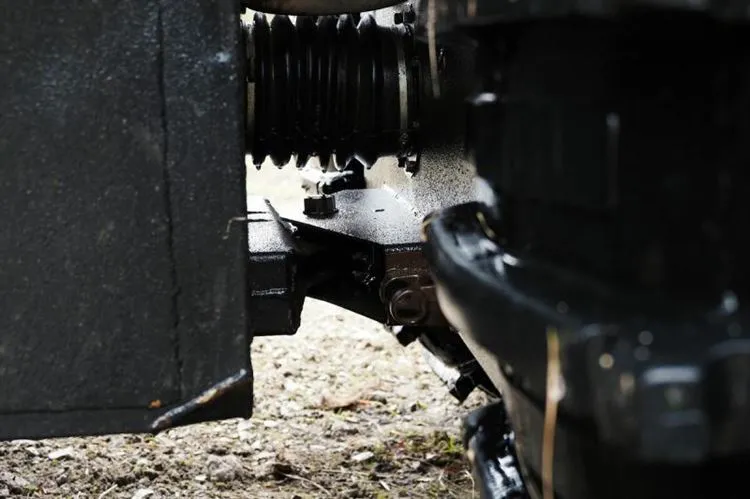
At first we were surprised by the low position of the air intake, but it turned out that the water level afloat is much lower. But the engine is located in the center, but in the rear compartment of the all-terrain vehicle, which makes its own adjustments to the management organization. I will return to him.
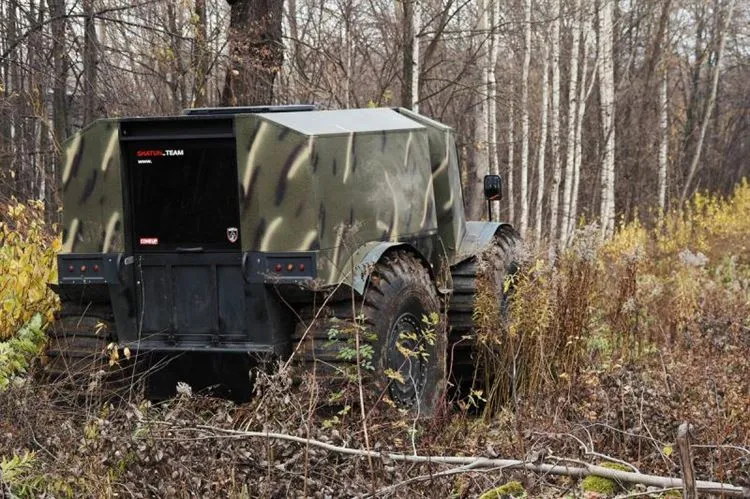
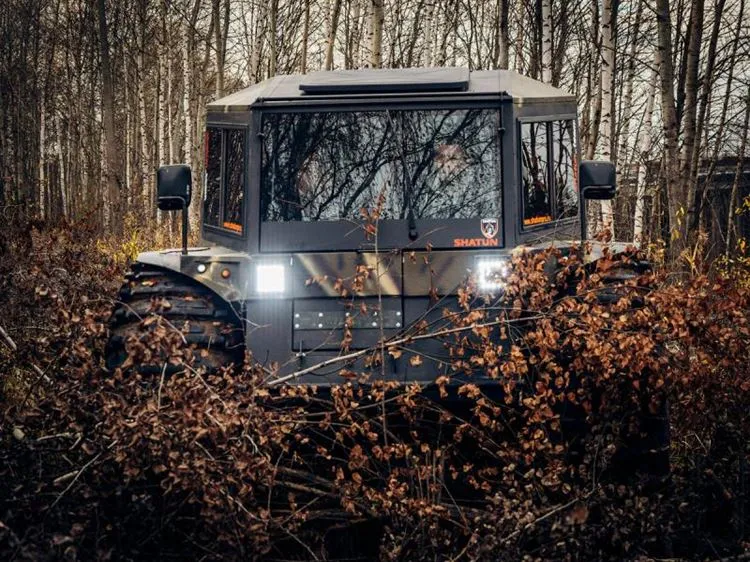
The driver and front passenger are loaded through the front hinged door, similar to the already mentioned Sherp. Rear passengers or cargo through the tailgate. The lower part of the tailgate does not drop down and climbing in without a step will be a difficult task for many. But as a table or platform, it is great.
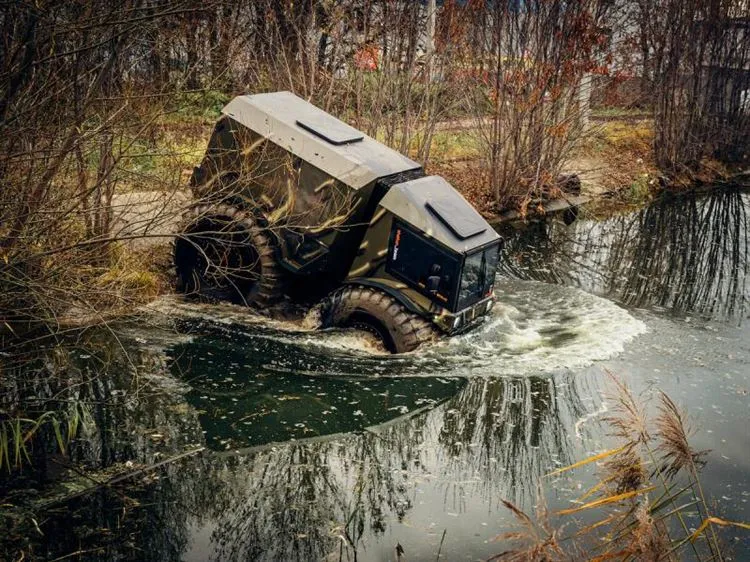
There are upper hatches in the roof of both compartments, and the front hatch is not needed in practice, but standing upright in the rear when the all-terrain vehicle is floating on the lake or climbing through the swamp is very exciting. Yes, and “unsportsmanlike hunters” will appreciate.
The rear compartment, in our case, was empty. Sitting there was uncomfortable and sometimes painful. In specific cases, the compartment is organized for the client: if you want – chairs, if you want – boxes for equipment. We figured it would be great to place two chairs across, a table-box and luggage racks on the sides of the body, so that there was room for organizing sleeping places.
The fuel tank is located at the rear of the all-terrain vehicle, and four more tanks are arranged in the niches of the rims for a reserve stock.
Technics and techology
Under the hood, or rather under the floor, approximately in the geometric center of the body, is a Kubota diesel engine. Due to the design features, the engine is aggregated by a manual gearbox deployed on the contrary from Lada Grant, while switching is also carried out non-standard – back and forth, that is, the first gear is to the right and back.
To transmit torque on the wheels, converted UAZ axles with installed interwheel differential locks are used. This is both good – there is easy access to spare parts, and bad – under serious loads, the details of the assembly can quickly say “hello”.
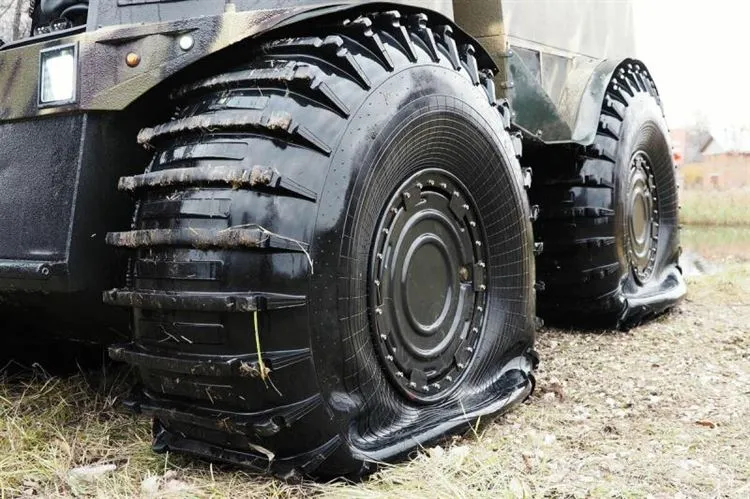
On board there is a stationary compressor, an autonomous heater and a pump for pumping out leaked water. The compressor, by the way, is not at all responsible for inflating the wheels, but for blocking. Wheels are inflated with exhaust gases and inflate faster than they deflate.
The manufacturer does not leave experiments and plans to introduce automatic transmission, which will significantly improve driver comfort. On difficult sections, you have to drive in one gear, since at low speed when switching, there is almost no “roll over” and the all-terrain vehicle practically stands up.
The cruising speed of the Shatun on asphalt is 45-50 km / h. In theory, the all-terrain vehicle can accelerate even more, but it will be “uncomfortable” and dangerous, at least. The element of such a technique is a measured movement in almost any conditions. We had a chance to ride along gullies and logging sites, and Shatun crawls along them without problems. You just have to choose the path.
Control
There are no levers or joysticks familiar from tractors in the cab of the all-terrain vehicle. Here is the usual car steering wheel, with the help of which the hydraulic drives are controlled. The rotation of the all-terrain vehicle is carried out using a “fracture” of the frame, but the angle of rotation is too large.
To increase maneuverability, a side-turn scheme is provided, implemented by braking the wheels from one side. The scheme has been tested for years, but in the case of the Connecting Rod, it has its drawbacks – with locked differentials, it will not work to turn around in a tight space. You will have to “unblock”, and this can not always be done quickly and safely.
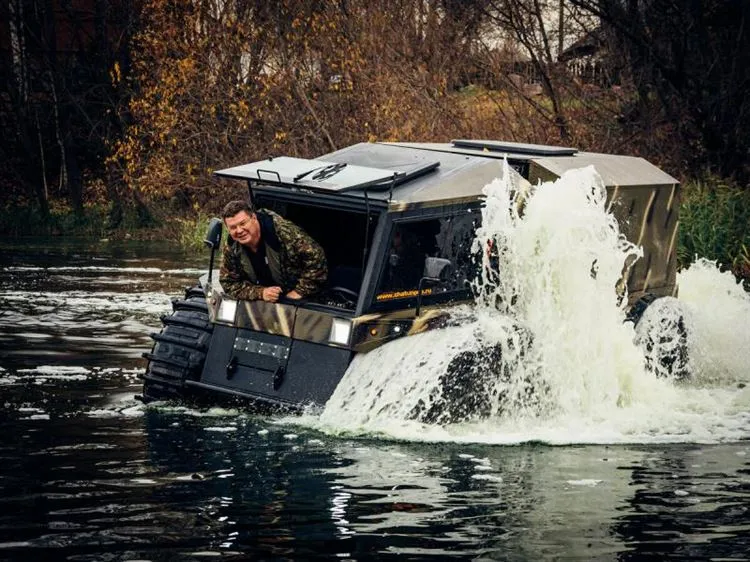
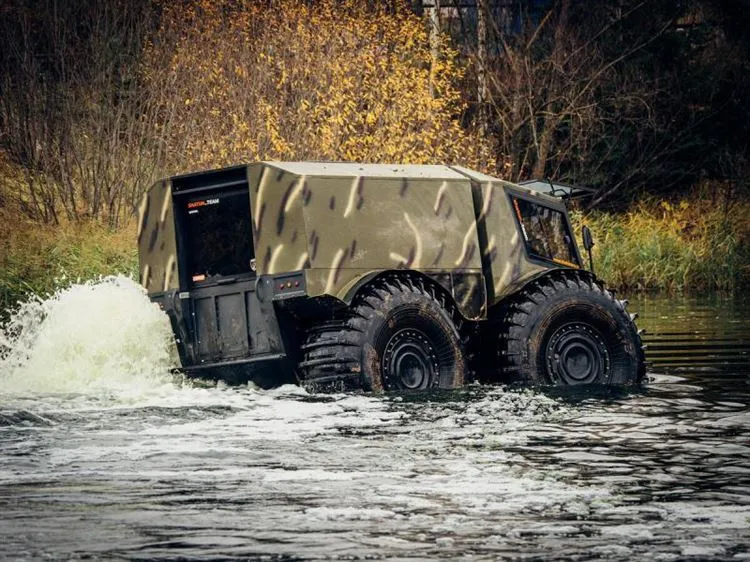
On the water, the connecting rod moves by rotating the wheels, and is controlled by a side-turn system, stopping the rotation of the wheels on one side. While driving, such a column of water escapes from under the front wheels that at first it seems that you are about to drown, but after a minute you are already enjoying the spectacle in the rear-view mirrors.
The crank is very confident in and out of the water, including getting out on a hard step and on uneven ground under a slope. The main thing is not to turn the all-terrain vehicle back through the roof, realizing some permissiveness.
The only inconvenience is caused only by the unusual arrangement of gears in the checkpoint, but it saves that there is no need to constantly change them in the direction of travel. According to the manufacturer of the checkpoint from Lada, it lives for a long time. The box is used in the construction of not only the Connecting Rod, but also other snow and swamp vehicles, which may seem strange to the layman.
Application tactics
Despite the growing popularity of special equipment among hunters, fishermen and travelers, it still remains a curiosity and is more used to entertain wealthy citizens. It is good to take guests for a ride at the recreation center or drive a couple of kilometers into the forest from the hunting base. The serious use of such equipment is limited by its characteristics and, as it is not banal, high cost.
The list of our tasks includes the delivery of four people and a fairly large amount of equipment to hard-to-reach places, which may take more than one day to reach. Accordingly, in addition to equipment and provisions, a serious margin of autonomy and comfort in motion will be required.
With comfort, everything is not so simple – inside the all-terrain vehicle, despite the presence of some sound insulation, it is quite noisy. With a high probability, this will not be solved with the help of vibration isolation, but will require structural changes in the suspension of the units, etc. For a day of driving in such noise, the head will become square, and in a few days…
Another issue is the placement of luggage and fuel supplies. Everything will have to shrink and act on the border and beyond the possibilities and ergonomics of technology. Given the need to climb into wild places, it will not be possible to pitch a tent everywhere, which only exacerbates the issue of arranging luggage and organizing sleeping places.
Our case is one big compromise of cross-country ability, comfort, size, reliability and autonomy, and not entertainment with “rides” for an hour in the nearest swamp. Therefore, no matter how good Shatun is in the field test, its disadvantages force us to abandon the idea of acquiring it for our projects. As they say, we will look.
The connecting rod is perfect for recreational or short-term tasks, both in the field of private use and in the field of special services. According to our canons, it is not suitable for organizing long trips, or, to be more precise, we are not ready to make a deal with our desires.
Technical data:
Engine: Diesel Kubota, 1500 cm3, 43 hp
Consumption: 3 liters per hour
Gearbox: mechanical, 5 tbsp., from Lada Granta
Transmission: 4×4, with interwheel differential lock
Length: 4000 mm, Width: 2520 mm, Height: 2300 mm
Curb weight: 1850 kg, Gross weight: 3 000 kg
Load capacity: 1000 kg
Land speed: 45 km/h
Water speed: approx. 5 km/h
Fuel tank: 70 liters + add. tanks on wheels
