
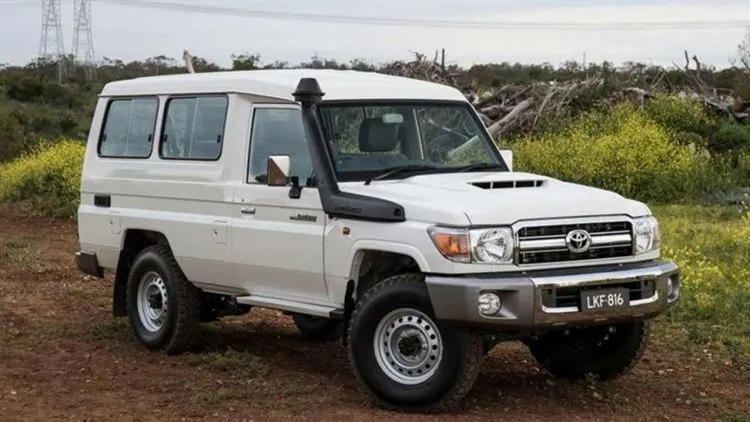
Toyota Land Cruiser 70: history, specifications, features
Cars that were produced for several decades without a change of generations are well known to local motorists using the example of Soviet industry products. However, this also applies to some specific vehicles of the global automotive industry, such as SUVs. So, in addition to the Niva and UAZ, many other cars of this type are known – Land Rover Defender, Mercedes Benz G, Suzuki Jimny and Toyota Land Cruiser 70.
The longest-running of the named models was the Land Cruiser 70 series, which is still in production despite the release of other series (the Defender was completed in 2016, and the rest, albeit rarely, changed generations). Below are the 70 series features and specifications.
General features
This car replaced in 1984 the simple working cars of the 40th series, and the 60th series occupied the niche of comfortable SUVs. Therefore, despite a significantly modified design and technical updates, the Land Cruiser 70 retained the main features of its predecessor, namely simplicity, reliability and cross-country ability. Due to this, the 70 series became very popular and was sold all over the world, with the exception of a few countries.
During its long history, the car has undergone several updates, as a result of which the geography of its sales has decreased. Thus, worldwide sales ended in 1999. After 2007, the car remained in the markets of Asia, Australia, the Middle East, Africa and South America. Along with this, the geography of production also changed: until 2009, the J70 was produced in Japan and Venezuela, after which production in Venezuela was completed. In 2015, production was moved from Japan to Portugal, where the vehicle is still in production, with new Land Cruiser 70s being delivered to select markets.
Chassis and body
As already noted, the car is based on the 40 series. Therefore, a ladder frame was used for it, however, instead of riveting, its elements were connected by welding, which made it possible to increase the cross-sectional area, increasing the strength of the structure. The car has different chassis options: 70/71 with a short wheelbase, 73/74 with a medium wheelbase and 75/77 with a long wheelbase (later the indexes were changed).
Initially, the J70 was introduced in a variety of options: with hard, soft, removable hard top, 3-door passenger and cargo vans, pickup trucks. The thickness of the body panels has been increased by 1 mm compared to its predecessor. The design was similar to the previous Land Cruiser, but more angular. At the same time, some stylistic elements (front fenders and dimensions) were retained.
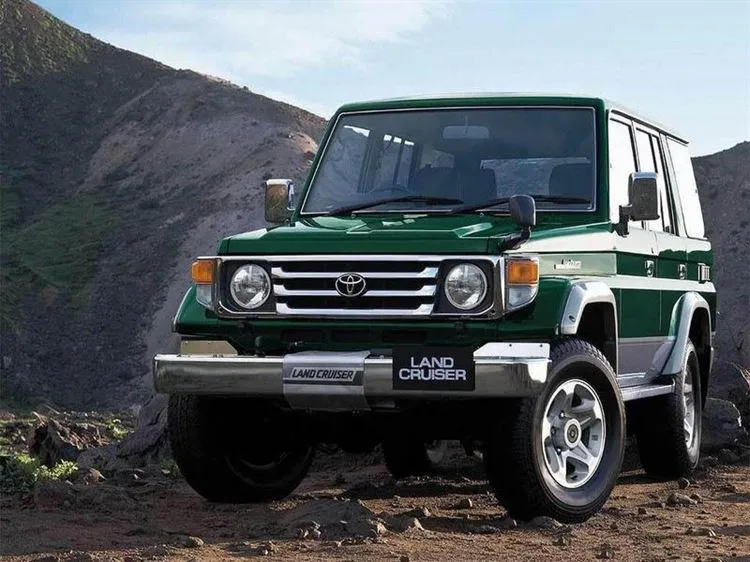
More civilian vehicles appeared in 1985 with the LG71-G station wagon, named Prado in 1990 (Land Cruiser II, Light Land Cruiser in export markets). It was used in later generations (90 series from 1997), but for more compact SUVs compared to the Land Cruiser. The car differed in design from the usual models of the 70th series.
In 1999, to increase the body, the step of the pickup was increased, which received the designation 79 series (van – 78 series).
In 2007, the design of the front end was significantly redesigned. In addition, the car received an extended chassis and caterpillar to accommodate the new V8 turbodiesel. To fill the niche of the missing economy versions in the 100 and 200 series, a 4-door station wagon (series 76), a pickup truck on a long chassis and a van (series 79 and 78) were created. In addition, a 300-unit commemorative version was introduced in Venezuela with additional off-road equipment.
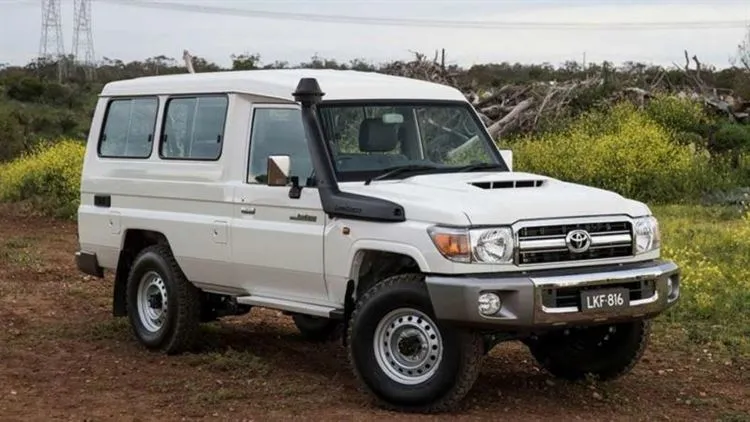
In 2012, a two-cab pickup truck was introduced on a long two-door pickup truck chassis, equipped with a 130 liter tank from the J79 station wagon.
In 2014, in honor of the 30th anniversary, a limited edition was introduced in Japan, which included the J76 4-door station wagon and the J79 double cab pickup equipped with a 1GR-FE with a 5-speed manual transmission.
Engine
Since the car has been in production for over 30 years and sold all over the world, it has been equipped with various engines.
Initially, the Land Cruiser 70 had two petrol and two diesel engines. The first are represented by inline 6-cylinder 4-liter 3F (155 hp, 303 Nm) and 22R 4-cylinder 2.4-liter (97 hp, 174 Nm). Of the diesel engines, a 2-liter of the same volume (76-87 hp, 155-165 Nm) and its 2L-T turbo engine (85-91 hp, 188 Nm) were used. These Hilux engines were installed in light J70s from 1984 to 1989.
The VM HR588 OHV 2.5 L (99 hp, 220 Nm) turbodiesel has been used on the J73 for the Italian market since 1987. This year, two more 3.4-liter diesel engines appeared: the 13B-T turbo engine (120 hp, 217 Nm) and the atmospheric 3B (98 hp, 226 Nm), which were used until 1989.
In 1990, the 3.5-liter 5-cylinder 1PZ (113 hp, 230 Nm) and the 4.2-liter 6-cylinder 1HZ (129 hp and 285 Nm) were introduced to replace the 3B and 13B-T.
In 1993, two more engines appeared: an in-line 6-cylinder gasoline 1FZ-FE with a volume of 4.5 liters (212 hp, 373 Nm) and a 3-liter 4-cylinder turbodiesel 1KZ-T (125 hp, 287 Nm). The first was installed until 2009, the second was used for Prado in the European market until 1996.
Since 2002, Australian J78/79s have been fitted with a 4.2-litre 1HD-FTE inline-6 turbodiesel in a non-intercooler version (164 hp, 380 Nm). Since 2007, this market has been using a 4.5-liter turbodiesel V8 1VD-FTV with a turbine (202 hp, 430 Nm).
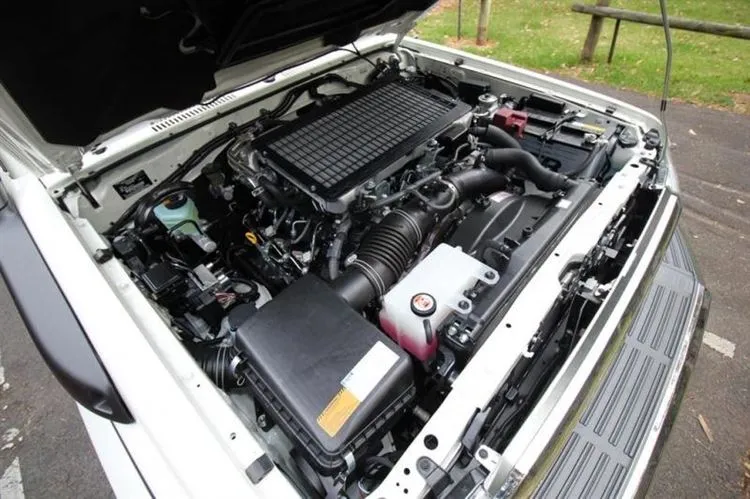
In 2009, the 1FZ/FZ-E was replaced in markets selling petrol variants, the 1GR-FE 4-litre V6 arrived (236/240 hp and 361/377 Nm depending on petrol). It was also used for the 30th Anniversary Edition in a Dual VVT-i version (270 hp, 392 Nm).
Transmission
The Land Cruiser 70 has all-wheel drive with a rigidly connected front axle (Part Time scheme) with free wheels in the hubs, a reduction gear, and no center differential. Some modifications are equipped with transverse differentials. The 70th series was equipped with both manual (R150F, R151F, H150F, H151F, H55F) and automatic (A40, A340, A440) transmissions.
Chassis
Initially, the Land Cruiser 70 had a classic design with dependent solid axles on leaf springs. Light versions received leaf spring suspension.
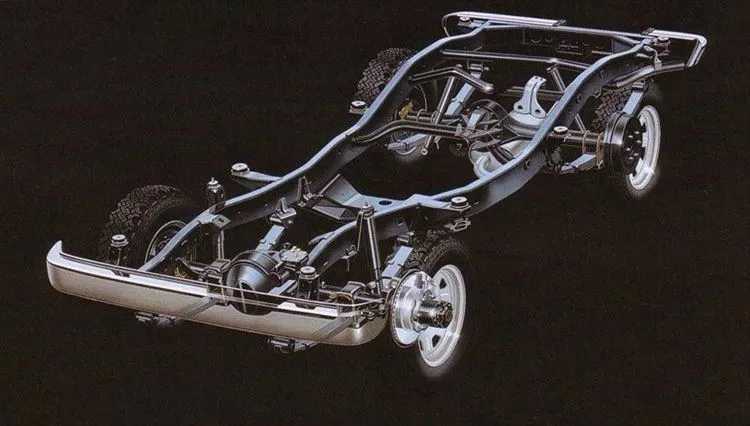
In 1999 and on other modifications of the Land Cruiser 70, the continuous front axle on leaf springs was replaced by a leaf spring suspension, and the rear springs were lengthened. Also, instead of 5-bolt wheels, 6-bolt ones were installed.
Salon
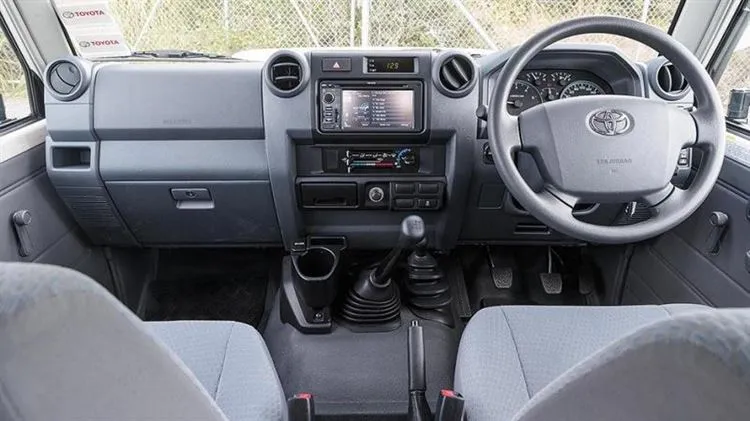
The 70 series is intended to have a very modest interior. More basic options like airbags only started to be added with the latest updates. So, in 2007, in some markets, for the first time, versions of station wagons and GXL pickups were introduced, which received advanced equipment. In this case, there are several options for the layout of the cabin. Among them are shortened versions, classic station wagons and cargo and passenger vans, where the rear seats are located on the sides. The capacity of the latter, according to the manufacturer, can reach 13 people, for which they belong to category D.
Price
Land Cruisers are highly valued in the current market. This is confirmed by the fact that they are among the least depreciating cars, which also applies to the 70 series. Thus, the cost of used cars starts from about 500 thousand conventional units and reaches 2-4 million copies in recent years. The new Toyota Land Cruiser 70 is not officially supplied to our market, but is imported on order.
