
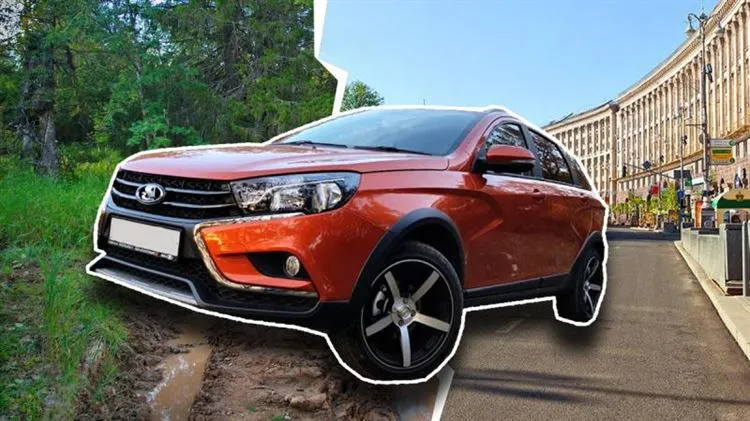
What is Vesta SW Cross good for and what’s under the hood
Without exaggeration, but Lada Vesta SW Cross is a unique car in the current market, and its uniqueness lies in the fact that it simply has no direct competitors in our country. This, of course, is emphasized on every occasion by the Togliatti automaker itself, positioning its “brainchild” as a “compromise between a hatchback, a full-fledged station wagon and a crossover.”
Moreover, if the Cross-prefix in this case means only one thing – like the “off-road essence” of a five-door, then the letters SW can be interpreted in two senses: on the one hand, they mean Sport Wagon, which is necessary to attract a young and active audience, and on the other hand, they are associated with passenger carriages of increased comfort (“SV” – sleeping cars).
And I must say, AvtoVAZ at least made the right decision by adding such a station wagon to its lineup, because current motorists really liked it. And this is not perceived as something out of the ordinary, because the Lada Vesta SW Cross actually successfully combines an emotional appearance and a high level of practicality, and all this for a relatively affordable price.
Objectively about the indisputable advantages:
- Emotional appearance – the car really looks attractive, balanced and emotional, and in many respects the credit for this belongs to the “off-road” entourage of unpainted plastic and large wheels with alloy wheels.
- Roomy interior – inside the cross-station wagon there is enough space both in the front and in the rear seats, and the inhabitants of both rows are not deprived of a minimum set of amenities (but a lot depends on the configuration).
- Large trunk – the five-door flaunts not only an impressive volume, but also a well-thought-out cargo compartment, with a full-size spare wheel underground, as well as an almost flat floor with a folded back of the rear sofa.
- High ground clearance – a clearance of 203 mm can be envied by many crossovers and even some SUVs, not to mention simple SUVs and cars. In addition to this, the station wagon has quite acceptable overhangs, which gives it excellent geometric cross-country ability.
- Modern equipment – already in the “base” the car boasts such options as airbags, climate control, cruise control, ABS, ESP, etc., not to mention more expensive versions.
- High-torque engines – of course, this cross-station wagon does not pretend to be a sports car in any way, however, the power of two (out of three offered for it) engines is quite enough for confident movement around the city and for safe overtaking on the highway.
- Inexpensive maintenance – yes, maintaining a car will cost more than the same Lada Granta, Priora, etc., but much cheaper than foreign cars, even in the budget category.
- Energy-intensive and comfortable suspension – the car perfectly “swallows” most of the road surface irregularities and assumes comfortable movement on almost any type of surface, be it asphalt or primer.
- The indifference of the hijackers is remarkable, but the all-terrain wagon (as, indeed, the Vesta family as a whole) is not interesting to representatives of the criminal world and practically does not appear in the statistics of the traffic police on theft.
- Good head lighting – despite the fact that the car, even in expensive versions, does not offer lensed optics, but the reflector headlights more than confidently cope with their direct duties.
- Predictable handling – the five-door not only holds the road well, but also readily responds to all manipulations of the steering wheel, and also has understandable feedback.
But enough about the good, what's wrong with the Lada Vesta SW Cross:
-
Mediocre sound insulation – too much extraneous noise gets into the car interior, and with a set speed, their number only increases.
-
High fuel consumption – with not the highest performance, engines really need a lot of gasoline (at least, according to tests and reviews of real owners, passport consumption differs significantly from the real one).
-
Congenital oil burner – even on new station wagons, oil consumption is observed: as a rule, at least one liter of oil is consumed for every 10 thousand km (this is especially true for a 1.8-liter engine).
-
Low build quality – even on new machines, extraneous noise, “crickets”, etc. can quickly appear. etc., and often the source of their occurrence is extremely difficult to determine.
-
Cheap finishing materials – not budgetary, but cheap plastics are used inside – very low quality, easily scratched even from minimal physical contact with them.
-
The high cost of wheels – only 17-inch “rollers” are offered for the car, which entails considerable costs when buying both summer and winter tires.
Let's go through the motors and transmissions:
When choosing Lada Vesta CSW Cross, many motorists have to make a difficult decision – which engine to choose, 1.6- or 1.8-liter? And then another question arises – and if a 1.6-liter, then which one? After all, two of them are offered for the station wagon – “VAZ” or “renoshny”.
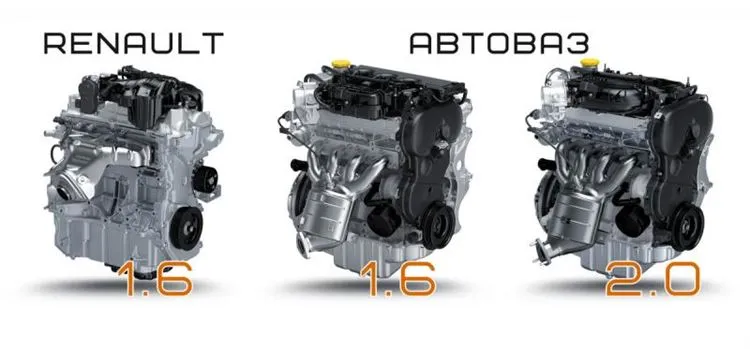
Renault or VAZ?
In general, both 1.6-liter engines are reliable and time-tested, but the domestic unit is clearly easier and cheaper to maintain. And here the main choice is different: if you want an “automatic” gearbox, then in any case you will have to take exactly the “renoshny” motor, since as soon as it docks with AT, and if you need a mechanical transmission, then “VAZ”.
And if VAZ, then 1.6 or 1.8?
If we compare Russian engines with a volume of 1.6 and 1.8 liters, then everything is not so obvious here:
- The 1.8-liter “four” is more complex, which is why it is more expensive to maintain, and also prone to oil consumption, but when it is mated with a quieter and more reliable “mechanics” from Renault and provides better dynamics (which in turn has a positive effect on safety).
- The 1.6-liter “aspirated” is generally more reliable and cheaper, but it is not so pleasant, for example, when overtaking on the highway, and it works in tandem with the problematic “VAZ” gearbox.
Automatic or stirrer?
Yes, often (especially for novice motorists) when buying a Lada Vesta SW Cross, the following dilemma arises – which gearbox to choose, automatic or manual?
By the way, despite the fact that AvtoVAZ stubbornly exploits the term “automatic transmission”, it must be understood that this means the Japanese Jatco variator (generally not bad, time-tested).
In this matter, it is more worth proceeding from your own preferences, since the variator (together with the “renoshny” engine) provides a more comfortable ride in urban conditions, but at the same time causes inconvenience on the track, especially when overtaking fast, and a mechanical transmission (sharing with a 1.8-liter engine) gives the station wagon a noticeably more dynamic character.
Well, in fact, everything you need to know about the first AvtoVAZ all-terrain wagon. If this information was useful to you – furiously like, subscribe and share with friends. If you think that we have missed something, silenced or over-praised – angrily write about it in the comments.
